First off, I noticed my first few posts didn't have the body text for some reason, so I've scraped the text off the emails from my sent folder and updated the following posts:
Wretch Machine
Livewire AFG
Livewire Chaos Computer
NAMM was pretty fun this year, but I felt rushed and didn't get to see as much as I wanted to (or if I did, not for as long as I wanted to)...nor did it seem like I had enough time to talk to everyone I wanted to. Part of it was only being there for 2 days, the other part was getting a late start to the show both of those days (almost 1pm on Saturday and 12 on Sunday). Seems like 5-6 hours would be enough each day, but it's totally not enough.
I'm now just trying to catch up on work and the pile of emails in my inbox...any spare time I have will be either spent working on a pair of mastering projects I need to get done before next week or just trying to figure out how I'm going to be able to afford all the cool new shit this year. Oh yeah, and make the modular case, and finish the joystick controller, and make some BYOC guitar pedals...maybe make some music too ;)
Tuesday, January 22, 2008


Monday, January 21, 2008
Elektron MonoMachine mkII

especially quality ones and ones that are not marketed as "techno/
groove boxes". I'd really like to pick up a Monomachine, but I think
I'll get most of the modular stuff out of the way first. But, I love
the MachineDrum and this guy is the perfect parter.
Elecktron MachineDrum mkII

about getting one, it's better than ever. 64 steps, thinner chassis,
and better powersupply. Best. Drum Machine. Ever.
Moog Mulitpedal

expression pedal (meh) it's also a 4 out CV expression pedal; each
output of which can be programmer for a different range or even
direction! Oh yeah, and those settings can be stored as presets! Man
if this thing also had some programmable patch bay (Moog, please
please please make this) this would be the ultimate expression pedal.
This is definitely on my short list.
MXR Silicon Fuzz

afficiando this might be one to add to the collection.
MXR Carbon Copy

find and spec sheets around, but I would guess from the sound it's
around 400ms. It also has some pretty rad green sparkle paint.
If you are the market for an analog delay, give this one some thought.
Doepfer A-138e Crossfader

favorite of the new Doepfer modules and one that I will definitley
picking up.
It's actually quite complicated and has different functions based on
what inputs are patched...I'm too lazy to type it all out (by fingers
are starting to cramp too) so just jump over to Analoguehaven or
Doepfer.de and read about it yourself. Snap.
Doepfer A-137-2 Wave Multiplier

This is essentially the same type of module as the Cyndustries Saw
Annimator. While that comparrison might not be accurate for how they
are desinged (I'm no EE, I have no idea how each gets the job done
under the hood) the audible effect is the same. They both take in a a
wave with some of ramp (Dieter even gave me a demo using a sine wave)
and mix in duplicate waves with phase ofsets...create a fat lush sound.
Where they definitely differ, however, is the Cyndustries one uses
built-in pitch-tracking LFOs to modulate phase while the Doepfer uses
manual controls with CV inputs.
I can see advantages with both approaches. The Cyndustries defintely
is the most stright forward and simple approach, especially if you
want the effect to track though a keyboard's range. But the Doepfer
seems like it would be more flexible since you can use your own LFOs
or any independent modulation sources as well have a greater deal of
timbre control in a static patch (no CV of phased waveforms). The
downside is it would be a little more complited to make it do what the
Cyndustries does in a single module; you're gonna need extrea LFOs/mod
sources.
The final difference is price, with the Doepfer being considerably
cheaper.
I was planning on getting the Cyndustries Saw Annimator but with
Deiter's new entry, I just might have a descision on my hands.
Metasonix Fucking Fucker

I surprised (although maybe I shouldn't have been). This is an
incredibly versitle guitar amp! The clean channel is fantastic...I
wonder why other amps have never included a phase knob, the variance
of tones available just with this knob alone was surprising. It might
be rediculous, but the clean (I mean, Happy) channel might have been
my favorite. The Reverb totally put over the top.
The Angry channel was also just as versitile, able to get tones
anywhere from a light over drive to an edgy/agreesive blues-y kind of
tone, to brutal crunch, to crazy distortion that reminded me of some
sounds from my TM-7.
I thought for sure that this amp be for those of us who already
understood Eric's modules and their unique sonics, but this amp is
truely for any guitar player. The current $5k price estimate probably
puts it out of the immediate reach of many (me included
ubfortunately), but any guitar player who doesn't scope this out as a
serious option for an amp is a serious idiot.
Consider this my official review. Eric, you win Bad Ass Mo Fo of the
year...get in touch with Samuel L. Jackson for your prize.
PS. I did get to see a pair of "middle-aged tone-questing" looking
dudes scoff at it while I was playing...I gave them a big shit-eating
grin and played the most obnoxious chord I could think of...with a
little bend thrown in for hood measure. That might have been the
highlight of the show.
STG Monkato Filter

rad sounds! I tweaked it for a few minutes then took this excessively
blurry shot.
UPDATED: From the comments from the Suit and Tie Guy himself:
well it's pretty simple. it's just a plain old four-pole lowpass filter with regeneration. however there's a positive output and a negative output at every pole.
this allows you to use the Mankato as a quadrature oscillator. also, it has an _extremely_ useable frequency range going from subaudio (one cycle every minute or three) into superaudio (eh ... way up there.)
Doepfer A-189-1 Bit Crusher

controlled bit crusher. Fairly straightforward CV control of bit
depth and sampling rate as well as a manual "Mode" knob which selects
the various possible audio abusing methods. Having a CV for the Mode
would have put it over the top for me, but this is an awesome no-
nonse, straightforward audio mangler.
BTW, I asked Dieter about the black knobs...they are on the new
modules only so that they are easily locatable as the new models in
his huge double monster size cases...they are not switching to black
knobs for production modules.
The Harvestman Zorlon Canon

interested in the random gates, I didn't think I'd be to into the
pitched noise aspect of it.
Well, I was totally wrong, the pitched noise is really cool! I was
having flash backs to some of my favorite video game sound tracks the
entire time. It's actually very musical in a lo-fi way and would make
a great percussion sound source. I can't believe I forgot to do this
since Scott had one in his case, but I was really curious to hear what
it would have sounded like through the Plan B Model 13.
Another aspect of the pitched noise half that I didn't actually think
about until now is that each output works individually and
simultaneously, so you could also mix together the various noise
outputs for an interesting timbre...especially if the mixer could also
phase invert, like the Doepfer A-138c or Plan B Model 14.
The Harvestman Tyme Sefari

is *so* much fun and finally getting a hands-on was fantastic! Scott
has done an awesome job with the panel layout...the module is
definitley one of those ones where you see yourself tweaking a lot in
realtime and the layout makes this really easy, even with cables
plugged in.
The switches are also really nice feeling. The are heavier duty that
the usual switched found on modules and feel like you can be a little
more "enthusiastic" with them during a performance. I'm so in love
with this module.
The Sound Of Thunder expansion module is fantasitc fun too...this is
definite a must have. Getting a wacky loop going and then flipping
those switches brought the biggest smile to my face!
Scott said he's got a few final tweaks to make to it and then its
ready to roll out!
Saturday, January 19, 2008
Livewire Chaos Computer

Ok I was pretty much sold on this thing from the first time I saw it last year, but after listening to a few short seconds I am completely smitten.
The Chaos Computer is the perfect blend between random and sequenced. The patterns it creates are random, but they tend to repeat and evolve slowly into different patterns. It's very musical.
The outputs were not what I expected either. The Gate output on each side is the straight clock signal (speed set by frequency knob) whereas the Binary out is a gate signal which occurs depending on the periocity of the shift registers...the random clock basically.
Also, I thought the Uniform/Gaussian outputs meant Stepped and Smoothed, but that's not the case at all. Both outputs are stepped; Uniform and Gaussian refer to the weighting of the voltage levels (or "notes" as Mike put it). So for example, using the Wide output under Uniform would be a large range of possible notes with an even weighting for all notes (meaning each note had the same probability of occuring). Fucking rad! This one is defintely a can't miss module for the eurorack crowd. Oh yeah, and the 8x8 LED matrix is cool as shit to watch in action! :)
Livewire AFG

I can't even begin to explain how huge this thing sounds. I had
anticaped a bug sound, but it's fatter than I had imagined! Just the
PWM alone sounded like two oscillators...with the dedicated Sub Out
(octave down) it's absolutely massive. I practically soiled myself.
Mike says it's just about ready to roll out the door; he estimated
only a couple of weeks...I'm so stoked!
The Wretch Machine

S-1000 was on display in the AH room complete with ribbon controller.
After playing with this kind of config @ AH Bay Area and again here @
NAMM, I'm convinced that this is *the* way to play the Wretch Machine!
I'm an idiot...
Well, you guys might want to kill me, but I left my digicam back
home...I know exactly where too...sitting on the floor charging. :p
home...I know exactly where too...sitting on the floor charging. :p
I've spent most if this morning in the Analogue Haven room. Lots of
cool stuff coming. I finally got to meet Mike Brown, Scott Jaeger,
and Dieter Doepfer. I talked to Peter for a while as well and he gave
me a sneak peak of his new Model 30 (or maybe its the 23). Either way
it is super rad!!! He said he was going to offcially announce it in
the next day or so, so I won't steal his thunder by letting the cat
out of the bag. Everyone will be really stoked though (and maybe
surprised). I also ran into Devi Ever and Eric up in the AH room...it
was like all my heroes were there in one place. I didn't get a chance
to play "The Fucking Fucker" yet...I have one more meeting today, so I
might not getvto it until tomorrow. Eric did say he's had hundreds of
people by each day so far! I'm stoker he's getting so much interest.
That's it for now, iPhone pics tonight when I have time to write some
captions.

Thursday, January 17, 2008

NAMM coverage
Well, I'm heading off tomorrow afternoon for Anaheim.
As I said before, I won't have my laptop, so in depth "Hi-Fi" coverage for those of you who've asked me to check stuff out won't be up until I get back on Tuesday.
However, being inspired by Devi's NAMM blog I'm going to email in posts from my iPhone periodically from the show. Lo-Fi coverage. ;)
BTW, anyone else interested in staying on top of the very latest from NAMM, the sonic state RSS feed seems to be a great source. As of course are the regular outlets, like Matrixsynth.
Also, Brandon's pics of the latest from NAMM are always great. He's even more artsy with the shots this year.
http://www.fdiskc.com/syn/namm/2008/index.html
As I said before, I won't have my laptop, so in depth "Hi-Fi" coverage for those of you who've asked me to check stuff out won't be up until I get back on Tuesday.
However, being inspired by Devi's NAMM blog I'm going to email in posts from my iPhone periodically from the show. Lo-Fi coverage. ;)
BTW, anyone else interested in staying on top of the very latest from NAMM, the sonic state RSS feed seems to be a great source. As of course are the regular outlets, like Matrixsynth.
Also, Brandon's pics of the latest from NAMM are always great. He's even more artsy with the shots this year.
http://www.fdiskc.com/syn/namm/2008/index.html
Wednesday, January 16, 2008
An update before the break
Not much has been going on here...just getting this sorted out before the trip down to NAMM.
I've been playing a lot more guitar lately and my guitar pedal fetish is starting to flouring. I want the new metasonix amp more than anything, but it's price point (though I'm sure well worth it) puts it out of my league for the time being. One day! In the meantime, I plan on building a bunch of BYOC kits as well as making an even more serious effort to obtain a TX-1 and TX-2.
The other reason for my increased guitar playing (other than it being fun and needing to work the rust out of my fingers) is that the modular is currently in shambles. Yes, shambles! I sold both of the Doepfer A-100P cases (thanks guys) but all the parts to put the custom case together have not arrived yet. They are estimated to arrive by next week, so I'll be getting started on that as soon as they arrive. It was actually kinda fun taking the modules out and getting a peek at their circuit boards, which I haven't seen since they were first put in the case. I had forgotten about some of the messages screened on the Livewire boards. :D
I'll also be without my laptop for an undetermined amount of time. I'm dropping it off tomorrow. I'll have my iPhone with me so I may be able to make some spurious posts from the NAMM show floor, but they might be rather brief so it might not be worth it. But I plan on taking plenty of pictures and will have a sizeable post when I return.
In the meantime, to tide you over, I present a composition originally done for a Xmas employee composition which, due to some serious hate from Logic, did not get finished. It's still not finished, but it's in a fairly progressed state and since it's the only real recording I've done in a while, I thought I'd share it. It's largely the MachineDrum and several tracks of the modular. There's a piano part in the break which is from one of Logic's sample sets. UAD Neve 88RS plugs were used to process each track and there's a little UAD Plate 140 and UAD RE-201 for ambience.
Comments welcome.
Enjoy.
PS. If anyone gets the reference made by the title, sound off in the comments. You'll win some nerd points. ;)
PPS. The first few seconds are only the sub-bass kick. If you don't hear anything, then yo speakers ain't big enough cuz!
I've been playing a lot more guitar lately and my guitar pedal fetish is starting to flouring. I want the new metasonix amp more than anything, but it's price point (though I'm sure well worth it) puts it out of my league for the time being. One day! In the meantime, I plan on building a bunch of BYOC kits as well as making an even more serious effort to obtain a TX-1 and TX-2.
The other reason for my increased guitar playing (other than it being fun and needing to work the rust out of my fingers) is that the modular is currently in shambles. Yes, shambles! I sold both of the Doepfer A-100P cases (thanks guys) but all the parts to put the custom case together have not arrived yet. They are estimated to arrive by next week, so I'll be getting started on that as soon as they arrive. It was actually kinda fun taking the modules out and getting a peek at their circuit boards, which I haven't seen since they were first put in the case. I had forgotten about some of the messages screened on the Livewire boards. :D
I'll also be without my laptop for an undetermined amount of time. I'm dropping it off tomorrow. I'll have my iPhone with me so I may be able to make some spurious posts from the NAMM show floor, but they might be rather brief so it might not be worth it. But I plan on taking plenty of pictures and will have a sizeable post when I return.
In the meantime, to tide you over, I present a composition originally done for a Xmas employee composition which, due to some serious hate from Logic, did not get finished. It's still not finished, but it's in a fairly progressed state and since it's the only real recording I've done in a while, I thought I'd share it. It's largely the MachineDrum and several tracks of the modular. There's a piano part in the break which is from one of Logic's sample sets. UAD Neve 88RS plugs were used to process each track and there's a little UAD Plate 140 and UAD RE-201 for ambience.
Comments welcome.
Enjoy.
PS. If anyone gets the reference made by the title, sound off in the comments. You'll win some nerd points. ;)
PPS. The first few seconds are only the sub-bass kick. If you don't hear anything, then yo speakers ain't big enough cuz!
Tuesday, January 08, 2008
Guitar Hero is officially out of control
Ok first off, this isn't, technically, a music/synth related post. I've tried to stray away from posting random shit I'm interested in and instead stay on task with music/noise related gear, but this one is close enough that I couldn't pass up.
Let me also say that I love playing Guitar Hero. I have GH1 and GH2 on PS2 and it's a blast, particularly when playing with friends (and with beer).
That being said, this Peavey Riff Master Pro System for GH is fucking ridiculous. If you are going to drop that much money on what essentially is a gutted real guitar and real PA system, just buy a fucking guitar and learn to play it. Start a band. Start a cover band if you must. This quite possibly could be one of the lamest things I have ever seen.
What I'm actually more puzzled by (actually *afraid of* might be the better choice) is if there are actually bands that play GH in front of people. And I don't mean like friends get together at a bar and watch others play...I mean there's a real show and venue and everything. Are there girls there? If I saw such a show I think I would throw up...right before I imploded. I don't know wether to be sad for or mad at the target market of this thing.
oh well. back to real life.
Let me also say that I love playing Guitar Hero. I have GH1 and GH2 on PS2 and it's a blast, particularly when playing with friends (and with beer).
That being said, this Peavey Riff Master Pro System for GH is fucking ridiculous. If you are going to drop that much money on what essentially is a gutted real guitar and real PA system, just buy a fucking guitar and learn to play it. Start a band. Start a cover band if you must. This quite possibly could be one of the lamest things I have ever seen.
What I'm actually more puzzled by (actually *afraid of* might be the better choice) is if there are actually bands that play GH in front of people. And I don't mean like friends get together at a bar and watch others play...I mean there's a real show and venue and everything. Are there girls there? If I saw such a show I think I would throw up...right before I imploded. I don't know wether to be sad for or mad at the target market of this thing.
oh well. back to real life.
Thursday, January 03, 2008
New year's update
Once again, it's been too long since my last update...
Firstly, I hope everyone had a good and relaxing holiday break!
No new modules since the sequencer, money has been slow, but I have got a few more mastering projects coming my way and I did get some money for the holidays but I'm trying not to blow through that so fast. That and, as you'll read, I've got more uses for it. That, and I've learned my lesson about buying stuff before NAMM.
Over the break, I got back into playing guitar more. It started with playing around with the TM-6 as a wah and for about a week I played guitar more than played with the modular. It was involved in a few sounds, using the filters mostly, but I generally was just using the guitar and having a lot of fun. Even not having played (or practiced, which I never did much anyway) I haven't gotten too rusty...it's certainly a lot easier to come up with riffs/lines on the guitar than the synth/keys for me and that's probably why I had so much fun.
This new attention to the guitar also rekindled my lust for pedals. I've always liked pedals, but was always buying and selling them as they didn't hold my attention very long...the few that did though, I have kept and I feel now, years later, that my ears have improved enough that I'm able to pick and choose pedals better.
Through Pete @ Leisure Cove, I got turned onto Build Your Own Clone and the DIY pedal kits that they offer. BYOC has quite a few kits, one that I am particularly excited about, the "Lazy Sproket", a Boss SG-1 Slow Gear clone. Despite it's simplicity, I really liked that pedal, but it was always way too expensive. It's the pedal that actually got me browsing eBay way back in 99 or thereabouts. I was always hunting for a Slow Gear...and was always outbid on the few that came up. Well now, I can build the thing myself for $74.99. Fuckin-A.
All of their kits are very interesting and very well priced. The other's that particularly interest me are the "250+" DOD 250/MXR Dist+ clone as well as their Digital Delay. The icing on the cake is their forum, which has a very active membership with what seems like hundreds of various mods to the kits. I'm *really* excited about getting into this.
In modular news, I've ordered the majority of the parts for my custom case and they should be arriving very soon. I actually ordered 2 extra of the Vector T-strut mounting rails since it was only a few more bucks to get the price break for 10 of them. So if anyone wants 2 rails, let me know and I'll give you a great deal; I don't think I'll have a use for them. I'm hoping to finish the case quickly and not drag ass like I have with the joystick controller. The fact that having the case finished will allow me to sell my Doepfer A-100P suitcases, therefore having money for modules, will be a big motivator. Which reminds me, I'll have 2 Doepfer A-100P cases available for sale soon too; if you are in the market for one (or both!) let me know.
I'm looking forward to NAMM again this year; I always have a good time, but I have very few work-related meetings lined up this year so I'll pretty much be cruising the show the entire time. I've got a few people to say hi to in person now which will be fun to. If any of you want me to check out anything specific @ NAMM, please leave a note in the comments (or this thread on the Muff Wiggler Forum) and I will make sure to check it out and get as many details as possible.
It's not all rainbow farts and sunshine here though, my MacbookPro has fucked itself up nicely. For the last month or so it's been acting oddly when charging batteries and I actually had to replace one of the batteries as it no longer held a charge for more than 30 minutes or so. Now, it simply refuses to run when the battery is used; it will only work when connected to the AC adapter. The battery is fine too, I've tested it with several colleague's MBPs as well as tried their batteries. The shitty part is that my MBP is out of warranty and I didn't buy the extended applecare. I've bought the extended applecare for every mac I've ever owned and never needed it, and this time, ever so ironically, skipped it with this laptop.
Actually the really sucky part is the fact that the wonderful MagSafe connector comes out so easily by design (to save your laptop from flying across the room should someone trip on the power cable)...now if I pickup the thing wrong and the plug pulls out, the computer dies...which has happened like 5 times in the last 2 weeks. Bad sectors anyone!? I've yet to back my system up and take it in for repair, so I'm in for an unknown charge in the near future (another reason to not go splurging on modules.
That's it for now. Adios.
Firstly, I hope everyone had a good and relaxing holiday break!
No new modules since the sequencer, money has been slow, but I have got a few more mastering projects coming my way and I did get some money for the holidays but I'm trying not to blow through that so fast. That and, as you'll read, I've got more uses for it. That, and I've learned my lesson about buying stuff before NAMM.
Over the break, I got back into playing guitar more. It started with playing around with the TM-6 as a wah and for about a week I played guitar more than played with the modular. It was involved in a few sounds, using the filters mostly, but I generally was just using the guitar and having a lot of fun. Even not having played (or practiced, which I never did much anyway) I haven't gotten too rusty...it's certainly a lot easier to come up with riffs/lines on the guitar than the synth/keys for me and that's probably why I had so much fun.
This new attention to the guitar also rekindled my lust for pedals. I've always liked pedals, but was always buying and selling them as they didn't hold my attention very long...the few that did though, I have kept and I feel now, years later, that my ears have improved enough that I'm able to pick and choose pedals better.
Through Pete @ Leisure Cove, I got turned onto Build Your Own Clone and the DIY pedal kits that they offer. BYOC has quite a few kits, one that I am particularly excited about, the "Lazy Sproket", a Boss SG-1 Slow Gear clone. Despite it's simplicity, I really liked that pedal, but it was always way too expensive. It's the pedal that actually got me browsing eBay way back in 99 or thereabouts. I was always hunting for a Slow Gear...and was always outbid on the few that came up. Well now, I can build the thing myself for $74.99. Fuckin-A.
All of their kits are very interesting and very well priced. The other's that particularly interest me are the "250+" DOD 250/MXR Dist+ clone as well as their Digital Delay. The icing on the cake is their forum, which has a very active membership with what seems like hundreds of various mods to the kits. I'm *really* excited about getting into this.
In modular news, I've ordered the majority of the parts for my custom case and they should be arriving very soon. I actually ordered 2 extra of the Vector T-strut mounting rails since it was only a few more bucks to get the price break for 10 of them. So if anyone wants 2 rails, let me know and I'll give you a great deal; I don't think I'll have a use for them. I'm hoping to finish the case quickly and not drag ass like I have with the joystick controller. The fact that having the case finished will allow me to sell my Doepfer A-100P suitcases, therefore having money for modules, will be a big motivator. Which reminds me, I'll have 2 Doepfer A-100P cases available for sale soon too; if you are in the market for one (or both!) let me know.
I'm looking forward to NAMM again this year; I always have a good time, but I have very few work-related meetings lined up this year so I'll pretty much be cruising the show the entire time. I've got a few people to say hi to in person now which will be fun to. If any of you want me to check out anything specific @ NAMM, please leave a note in the comments (or this thread on the Muff Wiggler Forum) and I will make sure to check it out and get as many details as possible.
It's not all rainbow farts and sunshine here though, my MacbookPro has fucked itself up nicely. For the last month or so it's been acting oddly when charging batteries and I actually had to replace one of the batteries as it no longer held a charge for more than 30 minutes or so. Now, it simply refuses to run when the battery is used; it will only work when connected to the AC adapter. The battery is fine too, I've tested it with several colleague's MBPs as well as tried their batteries. The shitty part is that my MBP is out of warranty and I didn't buy the extended applecare. I've bought the extended applecare for every mac I've ever owned and never needed it, and this time, ever so ironically, skipped it with this laptop.
Actually the really sucky part is the fact that the wonderful MagSafe connector comes out so easily by design (to save your laptop from flying across the room should someone trip on the power cable)...now if I pickup the thing wrong and the plug pulls out, the computer dies...which has happened like 5 times in the last 2 weeks. Bad sectors anyone!? I've yet to back my system up and take it in for repair, so I'm in for an unknown charge in the near future (another reason to not go splurging on modules.
That's it for now. Adios.
Thursday, December 13, 2007
Way Cool Controller
I'm sad that my joystick controller will not be as cool as this, The Thummer:
Via Paul S. on the AH list.
Via Paul S. on the AH list.
Wednesday, December 12, 2007
The Devils Carrousel
So here is the patch I mentioned last night after getting the Doepfer A-155.
The A-155 has Pre/Post outputs for each sequencer lane. "Pre" is pre-S+H/Glide processing and Post is post-S+H/Glide processing; but if you don't do any S+H/Glide processing, these are essentially a mult. That's how I used it in this case, with the Pre out going to the 1v/Oct in on the Plan B Model 15 and also into one oscillator's CV in on the Livewire Dalek Modulator which was set to a sine wave and put into one of the Freq CV inputs (linear) of the Model 15. The sine wave output of the M15 is then fed into one half of the M13 Dual Timbal Gate set to "Both" with the level all the way up.
The second lane of the A-155 is controlling the other oscillator of the Dalek, set to square wave and fed into the other half of the M13 Dual Timbral Gate, set to "Filter", with the Level all the way down. This gate is being opened by the Plan B Model 10 Poly EG.
The clock for the A-155 is the square wave output of one half of the Livewire Vulcan Modulator. The Difference output of the Vulcan is set for both square waves and it is being used to trigger the M10 which is opening that lower gate on the M13.
From the SUM output (mix) of the M13, the signal is fed into the Livewire FrequenSteiner, which is then modulated slowly by the triangle wave on the other half of the Vulcan as well as the Auxiliary output of the Livewire Dual Cyclotron. This gives an interesting sound because you don't really notice the Cyclotron's effect on the filter frequency when the Vulcan has swept it all the way up, but as it sweeps down, you can hear the Cyclotron's effect...it makes that kind of square wave gurgling sound when the filter frequency is in the lower range.
Finally, the volume is controlled by one of the EGs on the Doepfer A-143-2 which is being triggered by the Gate row on the A-155 sequencer. The release time is slow so it's really adding only a slight bit of dynamics to the sound. I'm also controlling the overall volume with one axis of my joystick controller inverted through the Doepfer A-175 Dual Inverter.
The final touch is the Moog delay (MF-104) with the Frostwave Resonator in the feedback loop to give it a bit more band-limited tape-delay like sound.
Enjoy.
The A-155 has Pre/Post outputs for each sequencer lane. "Pre" is pre-S+H/Glide processing and Post is post-S+H/Glide processing; but if you don't do any S+H/Glide processing, these are essentially a mult. That's how I used it in this case, with the Pre out going to the 1v/Oct in on the Plan B Model 15 and also into one oscillator's CV in on the Livewire Dalek Modulator which was set to a sine wave and put into one of the Freq CV inputs (linear) of the Model 15. The sine wave output of the M15 is then fed into one half of the M13 Dual Timbal Gate set to "Both" with the level all the way up.
The second lane of the A-155 is controlling the other oscillator of the Dalek, set to square wave and fed into the other half of the M13 Dual Timbral Gate, set to "Filter", with the Level all the way down. This gate is being opened by the Plan B Model 10 Poly EG.
The clock for the A-155 is the square wave output of one half of the Livewire Vulcan Modulator. The Difference output of the Vulcan is set for both square waves and it is being used to trigger the M10 which is opening that lower gate on the M13.
From the SUM output (mix) of the M13, the signal is fed into the Livewire FrequenSteiner, which is then modulated slowly by the triangle wave on the other half of the Vulcan as well as the Auxiliary output of the Livewire Dual Cyclotron. This gives an interesting sound because you don't really notice the Cyclotron's effect on the filter frequency when the Vulcan has swept it all the way up, but as it sweeps down, you can hear the Cyclotron's effect...it makes that kind of square wave gurgling sound when the filter frequency is in the lower range.
Finally, the volume is controlled by one of the EGs on the Doepfer A-143-2 which is being triggered by the Gate row on the A-155 sequencer. The release time is slow so it's really adding only a slight bit of dynamics to the sound. I'm also controlling the overall volume with one axis of my joystick controller inverted through the Doepfer A-175 Dual Inverter.
The final touch is the Moog delay (MF-104) with the Frostwave Resonator in the feedback loop to give it a bit more band-limited tape-delay like sound.
Enjoy.
I Finally Got a Sequencer

As I previously mentioned before, I've been on the lookout for a sequencer, the Doepfer A-155 in particular since the Milton is vaporware for the most part. I actually lost an auction one two weeks ago on ebay, and had been waiting for another to show up.
Then, yesterday, I saw a post to the AH list (I'm just a lurker, not a member) from a guy who was looking to sell one, and he was in Santa Cruz! I went and got it on my lunch break, and pretty much started at it on and off for the rest of the day. I ended up being at work until pretty late so it was about 10pm before I actually got around to plugging it in.
Before hooking it up though, I thought I would give organizing the "portable" system a shot. It wasn't really working out...I couldn't fit all that I wanted into 1 A-100P case...not with the Sequencer. If it was like 12HP or so smaller, then *maybe*. So I'll be starting on a custom case ASAP. With the Sequencer installed, I'm down to 22HP free.
So anyway, everything I said about not wanting a sequencer was simply uneducated bullshit rationalization on my part. I LOVE the sequencer...I think want two now! Just having one row patched to a 2 OSC FM sound was fantastic fun. I played around with it for about 3 hours, trying different clock sources, messing with using one of the trigger rows patched into the sequencer Reset to play with the sequence length in realtime, etc, but I think I've only just broken the surface of using this in patches. The A-154 controller will no doubt be in my future as well, especially if I decide on picking up a second A-155.
I did leave a patch up that I did at the end of the night, I just didn't record it; I'll do that tonight and update the post here with the audio.
Monday, December 10, 2007
Computers Make Me Mad
A disclaimer: I love computers. My day job is testing software. I use computers 18 hours out of every day. They still make me mad.
Case in point, at work they've decided to do this company compilation and give a copy of it to everyone for christmas. Everyone (who wanted to) was supposed to submit at least 1 track. I of course didn't find out about it until the last minute and only had a weekend before the deadline for submission. And by "weekend" I mean Sunday afternoon.
I actually was able to compose the backbone of the track on the MachineDrum Saturday night while "watching" TV. I also had a couple of modular patches in mind, both utilizing one of the joysticks that I've gotten wired up to a pair of patch cables. So I was rather excited because that short window of time on Sunday would simply be for tracking and quick mixdown. Easy peasy japanesy.
So I sit down Sunday afternoon, tweak on the patches for an hour or so and then decide to get down to tracking. I wanted to get each of the 12 tracks/sounds of the machine drum recorded onto it's own stereo track (stereo tracks because the machinedrum sounds had stereo verb and panning and delay on them and I wanted to preserve that). This meant syncing to MIDI Clock...no big deal right? Well, after about 20 minutes of hooking all that shit up, finding the sync settings on the MD and setting the right stuff up in Logic+AudioMidiSetup I finally got it going. Hit play in Logic...MachineDrum starts playing. Sweet! :D
Add new stereo track-> Solo kick track on MachineDrum -> Record 4 bars -> Stop -> Playback -> WTF!?
The recorded audio was actually being printed earlier than it should off; effectively making each hit fall earlier than the beat in Logic. I know it should not do this so I spend the next 2 hours trying to figure out why it was doing it...I gave up out of frustration after that. No new track, and more stress on the weekend. Fuck.
I still have no idea where the problem lies. I'm keen to blame Logic as that is a favorite pastime, but I don't necessarily know if it is purely at fault. I imagine it's a combination of Logic settings, the midi interface connection (Elektron TM-1) over USB and some good ol' MIDI slop.
The thing that really sucks is I can't let it rest until I figure it out...I know I'll end up in there tonight cursing and yelling and kicking things. Heroes isn't on, I'll have nothing else to do but lock myself away in the nerd cave and get pissed off.
:p
I'm also pissed off in general that this kind of setup doesn't "just work". I know it could be the USB hub, or just midi slop or some other unavoidable thing like that, but IMO, that's unacceptable. If MIDI Clock is supported it should fucking work, rock solid...if it's sloppy, what the fuck is the point, don't even put it on there. Same thing for USB midi interfaces...if you can't make it work reliably connected to a hub with a keyboard, mouse and dongle, don't fucking bother! It's not like I have cheap shit either.... ok, I'm getting off on a rant. :/
Fingers crossed for a happy ending.
Case in point, at work they've decided to do this company compilation and give a copy of it to everyone for christmas. Everyone (who wanted to) was supposed to submit at least 1 track. I of course didn't find out about it until the last minute and only had a weekend before the deadline for submission. And by "weekend" I mean Sunday afternoon.
I actually was able to compose the backbone of the track on the MachineDrum Saturday night while "watching" TV. I also had a couple of modular patches in mind, both utilizing one of the joysticks that I've gotten wired up to a pair of patch cables. So I was rather excited because that short window of time on Sunday would simply be for tracking and quick mixdown. Easy peasy japanesy.
So I sit down Sunday afternoon, tweak on the patches for an hour or so and then decide to get down to tracking. I wanted to get each of the 12 tracks/sounds of the machine drum recorded onto it's own stereo track (stereo tracks because the machinedrum sounds had stereo verb and panning and delay on them and I wanted to preserve that). This meant syncing to MIDI Clock...no big deal right? Well, after about 20 minutes of hooking all that shit up, finding the sync settings on the MD and setting the right stuff up in Logic+AudioMidiSetup I finally got it going. Hit play in Logic...MachineDrum starts playing. Sweet! :D
Add new stereo track-> Solo kick track on MachineDrum -> Record 4 bars -> Stop -> Playback -> WTF!?
The recorded audio was actually being printed earlier than it should off; effectively making each hit fall earlier than the beat in Logic. I know it should not do this so I spend the next 2 hours trying to figure out why it was doing it...I gave up out of frustration after that. No new track, and more stress on the weekend. Fuck.
I still have no idea where the problem lies. I'm keen to blame Logic as that is a favorite pastime, but I don't necessarily know if it is purely at fault. I imagine it's a combination of Logic settings, the midi interface connection (Elektron TM-1) over USB and some good ol' MIDI slop.
The thing that really sucks is I can't let it rest until I figure it out...I know I'll end up in there tonight cursing and yelling and kicking things. Heroes isn't on, I'll have nothing else to do but lock myself away in the nerd cave and get pissed off.
:p
I'm also pissed off in general that this kind of setup doesn't "just work". I know it could be the USB hub, or just midi slop or some other unavoidable thing like that, but IMO, that's unacceptable. If MIDI Clock is supported it should fucking work, rock solid...if it's sloppy, what the fuck is the point, don't even put it on there. Same thing for USB midi interfaces...if you can't make it work reliably connected to a hub with a keyboard, mouse and dongle, don't fucking bother! It's not like I have cheap shit either.... ok, I'm getting off on a rant. :/
Fingers crossed for a happy ending.
Thursday, December 06, 2007
Decisions, Decisions
As I mentioned somewhere in the past, I want to build a larger case for my modular but keep one of my A-100P cases as a "portable" system. I'm having a really hard time deciding either a) What exactly would go in this "portable" system or b) just not have a "portable" system and only have one larger case, which wouldn't be that much more less-portable.
The B case is very tempting. The case size I'm thinking of is ~28-32" wide and ~15" tall so it's still pretty portable as far as cases go. It wouldn't necessarily fit in the overhead compartment of a plane like the A-100P, but the likelihood of me traveling by plane and taking a modular with me *anytime* in the near future is pretty small. Plus, when I would take the modular somewhere (friend's studios, AH meetups, etc) I would have everything with me...I wouldn't be saying "if only I had x from my main system with me". The final benefit is that selling both A-100P cases would net more cash than just selling one...which means more money for modules.
The A case is tempting because I like "portable" gear in that kind of form-factor. I've always though the Buchla Music Easel was one of the coolest things ever. I would really enjoy having something like that. The reality is, I don't take stuff from my studio that often, and when I do, it's usually for doing audio processing over at a friend's studio...and typically that means filters, ring mods, etc and not oscillators or other "synth" components. The other crux with the A case is that I can't decide what to actually put in the system since it is a small amount of space and the modules that I really would want to have all the time are fairly large. Examples.
1) Livewire AFG - 28HP
I know it's not out yet, but I know I will want this osc all the time.
2) Livewire Vulcan Modulator - 14HP
After using this so much, I don't think I could substitute a pair of normal LFOs and not miss it. Sub-ing 2 LFOs might actually take up even more space. Add an extra 8HP for the Selector Expansion module when it's released.
3) Livewire Dalek Modulator - 14HP
Not only does it provide the ring mod functionality, but it's my main source for audio rate modulation. I couldn't imagine using the AFG without this. Sub-ing 2 oscs, even without ring mod would take up even more space.
4) Plan B Model 10 Poly EG - 12HP
Again, here's a module I couldn't see not having all the time, I would miss it's functionality if I subed in a standard Doepfer EG, which would only gain me 4HP anyway.
5) Plan B Model 13 Dual Timbral Gate - 12HP This one I might be able to live without all the time, BUT, it could also double as the main VCA (so long as I have some overall output atten somewhere) so that could actually save space.
6) Livewire FrequenSteiner filter - 16HP
This I've thought about over and over. The multi-mode is a basic requirement, the HP sounds really good and I would miss that. Also, self-oscillation is a requirement, so that would put out the Plan B M12 as a possible replacement (which would only save 2HP anyway). It also has a sound that's not too gritty, but not to smooth...it's rather perfect in the "character" range as far as filters go. It also has two CV ins, each with attenuators. These latter two qualities put it a bit ahead of the Polivoks as a substitute, that and the HP mode, which I would miss.
7) Some kind of mixer/attenuator - 8HP minimum
The Plan B Model 9 would be perfect here as it's both a mixer and attenuator simultaneously. It is 14HP, however. At a minimum, I'd need my Doepfer A-138c, 8HP.
So that brings us to 104HP, which leaves 60HP free. Despite my earlier statements on sequencers I actually do think I want one now and having it in here would be great...or at least, I would imagine I would want it once I got used to having it. That scratches off 50HP right that at a minimum. The other side of having a sequencer is that when I did take this system over to my buddies place for processing/sound design, I know he's gonna want to sync it to MIDI so that would take us into negative space with the MIDI-CV and clock divider. Plus, I didn't even count utility modules like VCAs and mults.
I guess I could go without the sequencer, toss in the Dual Cyclotron (28HP) or the Chaos Computer (28HP) whenever that actually gets released. The Chaos Computer might actually make an ok "sequencer" of sorts. You wouldn't necessarily be able to directly program the sequence, but you could influence it.
The final problem is that while I might have 60HP free, it's not 60HP in a row...it might 10 on top and 50 on bottom or 22/38, or something else. This can also restrict which modules I can actually choose.
I'm starting to loose track of thought now... Having one single case seems to be the simplest, sanest, least complicated way to go...but I've still got a soft spot for that "Portable" system. :/
What do you guys think?
The B case is very tempting. The case size I'm thinking of is ~28-32" wide and ~15" tall so it's still pretty portable as far as cases go. It wouldn't necessarily fit in the overhead compartment of a plane like the A-100P, but the likelihood of me traveling by plane and taking a modular with me *anytime* in the near future is pretty small. Plus, when I would take the modular somewhere (friend's studios, AH meetups, etc) I would have everything with me...I wouldn't be saying "if only I had x from my main system with me". The final benefit is that selling both A-100P cases would net more cash than just selling one...which means more money for modules.
The A case is tempting because I like "portable" gear in that kind of form-factor. I've always though the Buchla Music Easel was one of the coolest things ever. I would really enjoy having something like that. The reality is, I don't take stuff from my studio that often, and when I do, it's usually for doing audio processing over at a friend's studio...and typically that means filters, ring mods, etc and not oscillators or other "synth" components. The other crux with the A case is that I can't decide what to actually put in the system since it is a small amount of space and the modules that I really would want to have all the time are fairly large. Examples.
1) Livewire AFG - 28HP
I know it's not out yet, but I know I will want this osc all the time.
2) Livewire Vulcan Modulator - 14HP
After using this so much, I don't think I could substitute a pair of normal LFOs and not miss it. Sub-ing 2 LFOs might actually take up even more space. Add an extra 8HP for the Selector Expansion module when it's released.
3) Livewire Dalek Modulator - 14HP
Not only does it provide the ring mod functionality, but it's my main source for audio rate modulation. I couldn't imagine using the AFG without this. Sub-ing 2 oscs, even without ring mod would take up even more space.
4) Plan B Model 10 Poly EG - 12HP
Again, here's a module I couldn't see not having all the time, I would miss it's functionality if I subed in a standard Doepfer EG, which would only gain me 4HP anyway.
5) Plan B Model 13 Dual Timbral Gate - 12HP This one I might be able to live without all the time, BUT, it could also double as the main VCA (so long as I have some overall output atten somewhere) so that could actually save space.
6) Livewire FrequenSteiner filter - 16HP
This I've thought about over and over. The multi-mode is a basic requirement, the HP sounds really good and I would miss that. Also, self-oscillation is a requirement, so that would put out the Plan B M12 as a possible replacement (which would only save 2HP anyway). It also has a sound that's not too gritty, but not to smooth...it's rather perfect in the "character" range as far as filters go. It also has two CV ins, each with attenuators. These latter two qualities put it a bit ahead of the Polivoks as a substitute, that and the HP mode, which I would miss.
7) Some kind of mixer/attenuator - 8HP minimum
The Plan B Model 9 would be perfect here as it's both a mixer and attenuator simultaneously. It is 14HP, however. At a minimum, I'd need my Doepfer A-138c, 8HP.
So that brings us to 104HP, which leaves 60HP free. Despite my earlier statements on sequencers I actually do think I want one now and having it in here would be great...or at least, I would imagine I would want it once I got used to having it. That scratches off 50HP right that at a minimum. The other side of having a sequencer is that when I did take this system over to my buddies place for processing/sound design, I know he's gonna want to sync it to MIDI so that would take us into negative space with the MIDI-CV and clock divider. Plus, I didn't even count utility modules like VCAs and mults.
I guess I could go without the sequencer, toss in the Dual Cyclotron (28HP) or the Chaos Computer (28HP) whenever that actually gets released. The Chaos Computer might actually make an ok "sequencer" of sorts. You wouldn't necessarily be able to directly program the sequence, but you could influence it.
The final problem is that while I might have 60HP free, it's not 60HP in a row...it might 10 on top and 50 on bottom or 22/38, or something else. This can also restrict which modules I can actually choose.
I'm starting to loose track of thought now... Having one single case seems to be the simplest, sanest, least complicated way to go...but I've still got a soft spot for that "Portable" system. :/
What do you guys think?
Sunday, December 02, 2007
Polivoks Sawtooth Wave

So, I remembered I do have an oscilloscope...of sorts. I have Audiofile Engineering's Spectre, which does have an oscilloscope, but it's limited to what your audio interface can do, and unfortunately my 828mkII is not DC-coupled, so I can only use the software scope for audio rate stuff.
So anyway, that works perfectly for checking out what the waveform looks like when having the Harvestman Polivoks self-oscillate and have it's BP output FM itself.
I mentioned in the Polivoks review that it has a "saw-like sounding hybrid" when doing this...well I wasn't quite right...it IS a sawtooth!
It's a little quiet (amplitude-wise) than say, the Plan B Model 15, but it's a very cool and usable sawtooth wave. I had a lot of fun gating it with the Model 13 Dual Timbral Gate and even layering it with the Model 15, tuning it to harmonic intervals.
This is my first state-variable filter which has simultaneous LP/BP/etc outputs so I'm curious if other filters have a similar response when patched in such a fashion. Sound off in the comments if you know.
Saturday, December 01, 2007
Ghost In The ICs
Before sitting down to wrap up another mastering project and start on yet another (when it rains, it pours) I decided to patch up something on the modular for a while, making a specific effort to use the Polivoks.
After messing around with that sound of the Polivoks self-oscillating with the BP out FM'ing itself that I mentioned in the review, I started a patch using it as a regular BP filter and came up with what I called "Ghost In the ICs".
This quite possibly could be my favorite sound I've come up with yet. I think it could have been even more expressive with the joysticks involved, but it's hard at this stage to play them without the alligator clips popping off or having a flaky connection. Here's what the patch consisted of:
The lower register of the sound (the slightly formant like one) is one square wave oscillator from the Dalek Modulator with a little bit of x-modulation. That is being fed into the Harvestman Polivoks which has it's resonance about 3/4 of the way up, getting a slight modulation of it's frequency by the Auxiliary out of the Dual Cuyclotron (both cyclotrons set to "discrete"; square waves), and the Bandpass output going into one half of the Plan B Dual Timbral Gate with the level up @ 10 o'clock. The gate level is opened by the accent out on the first 8th note of a triplet on the Plan B Model 28 Tap Clock.
The upper register of the sound (higher pitched sine wave-ish one) is the sine wave out of the other half of the Dalek Modulator, also with a little bit of x-modulation. That is going directly into the other half of the Plan B Dual Timbral Gate, with the level also @ 10 o'clock and the gate in "Filter" mode. The gate level is closed slightly (not being opened wider) by a Plan B Model 10 Poly Env, with the envelope going negative (~ 11 o'clock on the knob). The Poly Env is being triggered by the triplet gate output on the Model 28 Tap Clock, with the middle 8th note set to Rest.
The mix/sum output of the Dual Timbral Gate is going into the Frequensteiner with it's Resonance set to ~ 10 o'clock and set to LP mode. It's modulated slowly by the Triangle out of one half of the Vulcan Modulator as well as getting an Accent on the first eighth note (so accents on the quater note beat) from the Model 28.
Finally, the Frequensteiner is going into the main VCA (Doepfer A-131) which is being held open via the "clock divider always on trick" and also slightly modulated by the Triangle out of the other half of the Vulcan Modulator.
I added a little UAD RE-201 and UAD Plate 140 in Logic after recording it.
Enjoy.
After messing around with that sound of the Polivoks self-oscillating with the BP out FM'ing itself that I mentioned in the review, I started a patch using it as a regular BP filter and came up with what I called "Ghost In the ICs".
This quite possibly could be my favorite sound I've come up with yet. I think it could have been even more expressive with the joysticks involved, but it's hard at this stage to play them without the alligator clips popping off or having a flaky connection. Here's what the patch consisted of:
The lower register of the sound (the slightly formant like one) is one square wave oscillator from the Dalek Modulator with a little bit of x-modulation. That is being fed into the Harvestman Polivoks which has it's resonance about 3/4 of the way up, getting a slight modulation of it's frequency by the Auxiliary out of the Dual Cuyclotron (both cyclotrons set to "discrete"; square waves), and the Bandpass output going into one half of the Plan B Dual Timbral Gate with the level up @ 10 o'clock. The gate level is opened by the accent out on the first 8th note of a triplet on the Plan B Model 28 Tap Clock.
The upper register of the sound (higher pitched sine wave-ish one) is the sine wave out of the other half of the Dalek Modulator, also with a little bit of x-modulation. That is going directly into the other half of the Plan B Dual Timbral Gate, with the level also @ 10 o'clock and the gate in "Filter" mode. The gate level is closed slightly (not being opened wider) by a Plan B Model 10 Poly Env, with the envelope going negative (~ 11 o'clock on the knob). The Poly Env is being triggered by the triplet gate output on the Model 28 Tap Clock, with the middle 8th note set to Rest.
The mix/sum output of the Dual Timbral Gate is going into the Frequensteiner with it's Resonance set to ~ 10 o'clock and set to LP mode. It's modulated slowly by the Triangle out of one half of the Vulcan Modulator as well as getting an Accent on the first eighth note (so accents on the quater note beat) from the Model 28.
Finally, the Frequensteiner is going into the main VCA (Doepfer A-131) which is being held open via the "clock divider always on trick" and also slightly modulated by the Triangle out of the other half of the Vulcan Modulator.
I added a little UAD RE-201 and UAD Plate 140 in Logic after recording it.
Enjoy.
Friday, November 30, 2007
Polivoks Filter Arrives
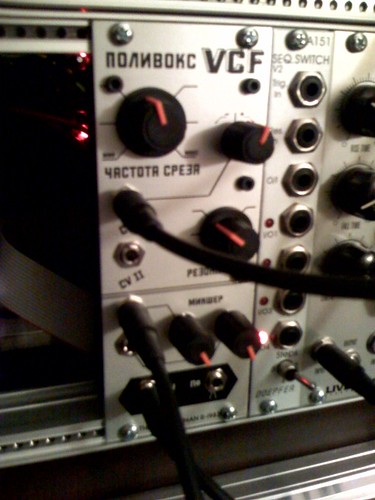
It sounds awesome! It's not as dirty as I thought it would be based on the description at Analogue Haven. I was expecting something different by the "self-oscillates with a dirty pulse" line. It sounds very similar to my SSM A-105 Doepfer LP filter, but a little edgier. The bandpass output is also pretty edgy, especially at high resonances. Overloading the filter (by using both inputs and turning them up all the way) sounds really cool too; a little more mean sounding that the Frequensteiner can be.
The bipolar attenuator for the one frequency CV input is a really nice touch. I wish the second input had one as well; it has no attenuator.
I did some FM of the filter while it was self-oscillating (no input) and I was very pleased. The Frequensteiner tends to saturate a bit when doing the same thing but the Polivoks stays nice and biting. I will enjoy using this as an extra sine wave source; something that I find the frequensteiner doesn't do as well. When you are really FM'ing the heck of it, it sounds really gritty and dirty, almost like noise (as in white, not "hiss")...very cool. One of my favorite sounds I have discovered so far is to listen to the LP out while the Polivoks is self-oscillating (no audio input) and patch the BP output into the non-attenuated freq CV in. The result is this saw-like sounding hybrid. I wish I had a scope so I could see what it looks like, but it sounds very interesting.
The one downside I have experienced is a personal one. The knobs, while very smooth and easy to turn, are a bit "wobbly". If anyone has a Dual Cyclotron, it's similar to the 3 selector pots which have a slight wobble to them. I've begun to get used to it, but it was a bit disappointing at first. I've noticed that no complaints have come from anyone on the harvestman list or back to Analogue Haven about this on the Polivoks or the Malgorithm so I think I'm being a bit overly anal; something that is not a rare occurrence. ;) I'm sure once I have a few more Harvestman modules in my collection, it won't stand out as much. It of course has no impact on the sound, just my OCD.
All in all, it's an awesome filter and definitely needs to be in your collection, especially if you like having many different filter flavors.
Tuesday, November 27, 2007
Modulars = crack (aka the Sawtooth Animator post)

Ok, so I now fully understand the modular addiction. I knew before that it was one of those "black hole" hobbies that will always have some new thing to buy or entail some never ending quest to have "the ultimate" setup. That's all well and good...but when you start rationalizing dipping into savings or not buying certainly family members christmas presents, that's an addiction my friends.
http://www.blogger.com/img/gl.link.gif
I should know better too...I have an addictive personality. I don't gamble, cause I know that would get me into trouble...I quit smoking several years back, which is still difficult to fend off urges, and I'm very careful about not drinking outside of social/recreational means. I guess I always rationalized "gear" as not being an addiction.
Then again, maybe I'm being over dramatic. It's just that there are all of sudden more things that I want than I can afford...and I have money, but it's the "don't touch this except for emergencies and save until you are old" money. And of course, I'm trying to rationalize new modules that I want as "emergencies".
The Cyndustries Sawtooth Animator is the newest item to the WANT BAD list. This comes in right after the Livewire AFG...I have wet dreams of what the two sound like together. Previously, this was only available in the Cyndustries usual Modcan A format and I had seriously contemplated starting a small satellite system in that format simply so I could have the Sawtooth Animator. Well, now it's coming to Eurorack and Frac formats!!! Muff and Matrix have already got the jump on it. You must check out the audio demos here.
Aside from making me extremely excited, it also makes me a tad bit depressed that I'll either have to wait to have it, or be poor for a while. Back-alley sexual favors for modules is most definitely out of the question.
Joystick Proto - very early
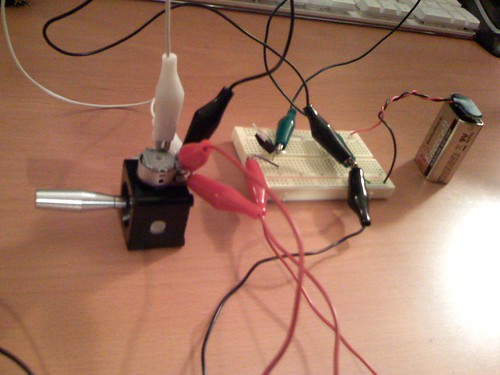
So this weekend I finally dragged my ass down to Radio Shack and picked up a few necessary parts (protoboard, alligator clips, voltage regulator, etc) to start working on my little joystick controller.
Because I'm an idiot, it took me about 2 hours to do what should have taken about 5 minutes. I didn't fully understand the whole two hemispheres of the protoboard and this caused me to burn up 2 LEDs (2 *overpriced* LEDs I might add) as well as not get the voltage regulator working. Once I finally understood that, I succeeded in almost burning up one of the axis pots of the joystick. See, I didn't (don't, actually) understand the whole "shit's gotta be goin back to ground" principle and I have ~5V just sitting there in the joystick's pot. :P
Anyway, by the end of the sitting, I had a working prototype which is what you see in the picture above. And I did had a few hours of fun hooking it up with the modular and I'm really excited about getting it done. In addition to the one joystick pictured, they'll be a second joystick (without it's retention springs removed) and a handful of trigger/gate buttons. This weekend I hope to find a nice enclosure and start soldering stuff together. Of course, I'll document the rest of the process as much as I can.
Friday, November 23, 2007
Workspace and Environment
My interview for Trash_Audio's Workspace and Environment series is now up. Stoked!
http://trashaudio.blogspot.com/2007/11/workspace-and-environment-james-cigler.html
http://trashaudio.blogspot.com/2007/11/workspace-and-environment-james-cigler.html
Sunday, November 18, 2007
ZombieThunder
So I'm the processes of trying to narrow down what modules that I will keep in a single Doepfer A100P suitcase as a "portable" system; the rest will go into a custom case which I am about to start working on.
I started this decision processed basing the results purely on space, but pretty soon that became too difficult and I figured it would be best to just start taking notes on what modules I use most when making patches. One of the more interesting patches I happened on was this one, which I named, ZombieThunder. It sounded like thunder and something I would have heard in a zombie movie soundtrack.
Of course, I took notes on what modules I used, but I didn't on exactly how they were patched...I'm describing it from memory here....
Plan B Model 15 sine is main sound source
Dalek Modulator sine wave was FM'ing the Plan B Model 15
Dalek Modulator other sine wave was FM'ing the FrequenSteiner (LP mode)
Plan B Model 24 stepped voltage (smoothed through Livewire Dual Bissell) was controlling pitch of Model 15
Plan B Model 24 smooth voltage was controlling the 2nd sine wave freq on the Dalek (the one FM'ing the filter).
Livewire Vulcan Max out was also modulating the Filter (although much more slowly).
Plan B Model 10 in LFO mode was opening up the main VCA.
Enjoy.
I started this decision processed basing the results purely on space, but pretty soon that became too difficult and I figured it would be best to just start taking notes on what modules I use most when making patches. One of the more interesting patches I happened on was this one, which I named, ZombieThunder. It sounded like thunder and something I would have heard in a zombie movie soundtrack.
Of course, I took notes on what modules I used, but I didn't on exactly how they were patched...I'm describing it from memory here....
Plan B Model 15 sine is main sound source
Dalek Modulator sine wave was FM'ing the Plan B Model 15
Dalek Modulator other sine wave was FM'ing the FrequenSteiner (LP mode)
Plan B Model 24 stepped voltage (smoothed through Livewire Dual Bissell) was controlling pitch of Model 15
Plan B Model 24 smooth voltage was controlling the 2nd sine wave freq on the Dalek (the one FM'ing the filter).
Livewire Vulcan Max out was also modulating the Filter (although much more slowly).
Plan B Model 10 in LFO mode was opening up the main VCA.
Enjoy.
Livewire Dalek Modulator Demo
This is a demo I have been looking forward too for a while. The Dalek is one of my fav modules because it is so useful, not only as a tone source, but as a modulation source; the latter I use the most frequently.
I tried to showcase it "on it's own" as much as possible since all the other video demos I have done so far have feature the Dalek in some shape or form. So without further ado...here's the Livewire Dalek Modulator.
Enjoy.
I tried to showcase it "on it's own" as much as possible since all the other video demos I have done so far have feature the Dalek in some shape or form. So without further ado...here's the Livewire Dalek Modulator.
Enjoy.
Sunday, November 11, 2007
Trash Audio Studio Tour
After being sick last weekend and busy all week (and saturday with a mastering project) I finally got around to making a video tour for my upcoming Workspace and Environment interview on Trash_Audio. It was Surachai's idea to make a video and it came out better than I expected.
Rather than narrate this one, I thought I'd give you all a break from my voice and instead write a quick piece as the sound track. And, it made sense to use the stuff being shown in the video.
Enjoy.
Rather than narrate this one, I thought I'd give you all a break from my voice and instead write a quick piece as the sound track. And, it made sense to use the stuff being shown in the video.
Enjoy.
Thursday, November 08, 2007
The Wishlist
I don't think I've posted a "wishlist" yet. I know I've mentioned modules that were "in the pipe" for purchase, but that isn't quite the same thing...so here' goes:
1) Livewire Audio Frequency Generator (AFG!...is it here yet?! Is it here?!)
2) Plan B Model 9 Mixer/Atten. <- this is a rad module...simple and effective and multipurpose. And cheap!
3) The Harvestman 1973 Tyme Sefari <- I've been excited about this one for a while, but now that it's getting farther along, I can't wait. I might be more anxious to get this than the AFG.
4) Livewire Chaos Computer <- who knows when this thing will ship...but when it does, I want it.
5) Plan B Model 14 Voltage Processor <- So much more than just a mixer, this thing is a full on voltage tweaker; a must have if you have many modulation sources.
6) The Harvestman 1986 Zorlon Canon <- Another Harvestman that I'm getting more excited about as it nears shipping. The pitched noise sounds like it will be very cool, but I'm fantasizing about using the various gates to drive the Chaos Computer
7) Plan B Model 21 Milton Grande <- An evasive beast like the Chaos Computer, but this is the only sequencer that I've seen that really makes me want to get a sequencer. Once it's released and cash is plentiful, it will be mine.
Filters
I'll list the filters separate because I like having several different filters to choose from, but I don't want more filters as bad as some of the above modules. Maybe that's a good testament to how pleased I am with the Livewire Frequensteiner. ;)
1) Plan B Model 11 Evil Twin <- I love bandpass filters, but I tend to like to get filters which have more than one mode. Based on the sound demos though, this bad boy is the exception.
2) The Harvestman 1982 Polivoks VCF <- A fresh off the assembly line release and it's a brilliant idea; and it's a dead-on reproduction, even using Russian ICs and not US counterparts. It was also developed with the help of the Polivok's original designer. Based on what I've heard of the Polivoks, this thing is mean as hell. It also has simultaneous Lowpass and Bandpass outputs. Actually...this guy will probably bump the Model 11 out of the number one spot...audio demos will be final judge.
3) Cwejman DMF-2 <- If my thirst for filters isn't quenched by both the Harvestman and the Model 11 (and the Metasonix TM-6 and the Frostwave Resonator) then I will have to pick this guy up. I've been told that the Cwejman's don't have the character that I usually go for in a filter, but a "matched" stereo set would be a little too much to pass up...I love stereo filtering.
Well, that's the list. For now anyway. I only hope the bank account can survive it all.
1) Livewire Audio Frequency Generator (AFG!...is it here yet?! Is it here?!)
2) Plan B Model 9 Mixer/Atten. <- this is a rad module...simple and effective and multipurpose. And cheap!
3) The Harvestman 1973 Tyme Sefari <- I've been excited about this one for a while, but now that it's getting farther along, I can't wait. I might be more anxious to get this than the AFG.
4) Livewire Chaos Computer <- who knows when this thing will ship...but when it does, I want it.
5) Plan B Model 14 Voltage Processor <- So much more than just a mixer, this thing is a full on voltage tweaker; a must have if you have many modulation sources.
6) The Harvestman 1986 Zorlon Canon <- Another Harvestman that I'm getting more excited about as it nears shipping. The pitched noise sounds like it will be very cool, but I'm fantasizing about using the various gates to drive the Chaos Computer
7) Plan B Model 21 Milton Grande <- An evasive beast like the Chaos Computer, but this is the only sequencer that I've seen that really makes me want to get a sequencer. Once it's released and cash is plentiful, it will be mine.
Filters
I'll list the filters separate because I like having several different filters to choose from, but I don't want more filters as bad as some of the above modules. Maybe that's a good testament to how pleased I am with the Livewire Frequensteiner. ;)
1) Plan B Model 11 Evil Twin <- I love bandpass filters, but I tend to like to get filters which have more than one mode. Based on the sound demos though, this bad boy is the exception.
2) The Harvestman 1982 Polivoks VCF <- A fresh off the assembly line release and it's a brilliant idea; and it's a dead-on reproduction, even using Russian ICs and not US counterparts. It was also developed with the help of the Polivok's original designer. Based on what I've heard of the Polivoks, this thing is mean as hell. It also has simultaneous Lowpass and Bandpass outputs. Actually...this guy will probably bump the Model 11 out of the number one spot...audio demos will be final judge.
3) Cwejman DMF-2 <- If my thirst for filters isn't quenched by both the Harvestman and the Model 11 (and the Metasonix TM-6 and the Frostwave Resonator) then I will have to pick this guy up. I've been told that the Cwejman's don't have the character that I usually go for in a filter, but a "matched" stereo set would be a little too much to pass up...I love stereo filtering.
Well, that's the list. For now anyway. I only hope the bank account can survive it all.
Saturday, October 27, 2007
Livewire Dual Bissell Generator Demo
As promised, it's a two for one weekend ;) Here is the video demo of the Livewire Dual Bissell Generator. A simple module, but one of my favorite "tweaking" ones.
Enjoy.
Enjoy.
Plan B Model 10 Demo
Man, I was really off my game today. Tripping over my own words and loosing my train of thought mid sentence. Thank god for video editing. I almost thought of keeping a gag reel, but it takes up so much HDD space.
With that said, I proudly present the Plan B Model 10 video demo.
Enjoy.
With that said, I proudly present the Plan B Model 10 video demo.
Enjoy.
Tuesday, October 23, 2007
Controller Quest
So in the process of mulling over this idea of making a custom Eurorack case, I finally decided that I do want to keep one of the Doepfer suitcases with a select few modules as a "performance" system; everything else would go into the custom made case. Hell, I might not even make the custom case and just get that Plan B case that was announced a while back...either way, I'm keeping one Doepfer suitcase as the "performance" system.
So that got me thinking about a controller for it. I don't want to have to use the Doepfer A-190 MIDI to CV converter as that will take up valuable space. I'd also like to have a unique (and better) controller than a shitty little MIDI controller. It's also a perfect opportunity for me to build something myself.
So my first thought was something with a joystick. I had wanted to get one of the Doepfer A-174 Joystick modules, but it always seemed like it would be taking up valuable space. Well, it turns out you can get the bare joysticks from Doepfer, and rigging them up as 0-5v+ attenuators seems relatively simple. Apparently they also come spring loaded (so the stick is always in the center). You can easily tear the springs out and make them free floating as well. Ripping the springs out is irreversible, however, so I thought of getting two joysticks, ripping the springs out of one, and adding a couple of buttons for triggers. Maybe lay it out similar to an old arcade game; I could probably even find the same style buttons. Perfect, this is simple, unique, and in theory, easy for me to put together.
But...it got me to thinking that, at some point, I will undoubtedly need to play something at standard pitches. So I revamped my design...keep the two joysticks, add a 2 octave keyboard, and maybe keep the trigger buttons if necessary (I could always use a keyboard key to trigger). Probably even add mults, and possibly even VCAs directly on the controller rather than take up more of that valuable space in the suitcase.
Well, I can't really find a definitive schematic or anything for taking a regular keyboard (like a fatar replacement, or even ripping the one out of my cheapo m-audio oxygen 8) and converting that to CV.
Does anyone have any leads on making your own CV keyboard? I spent a while googling around, and aside from this item on musicfromouterspace (which might not even be the right thing) I can't find anything.
So that got me thinking about a controller for it. I don't want to have to use the Doepfer A-190 MIDI to CV converter as that will take up valuable space. I'd also like to have a unique (and better) controller than a shitty little MIDI controller. It's also a perfect opportunity for me to build something myself.
So my first thought was something with a joystick. I had wanted to get one of the Doepfer A-174 Joystick modules, but it always seemed like it would be taking up valuable space. Well, it turns out you can get the bare joysticks from Doepfer, and rigging them up as 0-5v+ attenuators seems relatively simple. Apparently they also come spring loaded (so the stick is always in the center). You can easily tear the springs out and make them free floating as well. Ripping the springs out is irreversible, however, so I thought of getting two joysticks, ripping the springs out of one, and adding a couple of buttons for triggers. Maybe lay it out similar to an old arcade game; I could probably even find the same style buttons. Perfect, this is simple, unique, and in theory, easy for me to put together.
But...it got me to thinking that, at some point, I will undoubtedly need to play something at standard pitches. So I revamped my design...keep the two joysticks, add a 2 octave keyboard, and maybe keep the trigger buttons if necessary (I could always use a keyboard key to trigger). Probably even add mults, and possibly even VCAs directly on the controller rather than take up more of that valuable space in the suitcase.
Well, I can't really find a definitive schematic or anything for taking a regular keyboard (like a fatar replacement, or even ripping the one out of my cheapo m-audio oxygen 8) and converting that to CV.
Does anyone have any leads on making your own CV keyboard? I spent a while googling around, and aside from this item on musicfromouterspace (which might not even be the right thing) I can't find anything.
Thursday, October 18, 2007
PlayThing-amagoop
The comments (mainly Zerosum's) on the last Thingamagoop post got me thinking about demoing one application of the Thingamagoop. I was initially thinking of video ideas, but as I was playing around I got to jamming with it and it was too fun not to capture.
There is some modular processing applied:
The Thingamagoop (Ghost of Robot TB1X model, although that doesn't really matter) was plugged into the Doepfer A-119 Envelope Follower into the Ext. In of the Dalek Modulator. Ring Out of the Dalek into the Frequensteiner in bandpass mode, through the Doepfer VCA and then finally into the Moog MF-104 delay. There's some slight slow modulation of the Frequensteiner by the Vulcan Modulator and a touch of filter FM from the Plan B Model 15, the amount of which is being randomly controlled by the Dual Cyclotron.
Where the trick comes in is that I have the Threshold on the Envelope Follower set so that when I have my finger over the Thingamagoop's nose (blocking it's photocell), there is no gate output (and therefore no output from the Thingamagoop+modular). So I'm able to mute the sound just by putting my finger over the photocell.
Now, the modular processing imparts only a little bit of character; 90% of what you hear is the Thingamagoop and me flipping it's switches and playing with the LFO speed. It's pretty much impossible to pick out exactly when the FM of the Frequensteiner happens and the Ring Modulation is not that aggressive. I could have easily just run the Thingamagoop into the delay, but the modular added a nice character.
The left most switch on the Thingamagoop selects the "gate mode". Up is a square wave gate, controlled by the LFO speed. Down is no gate at all. It's pretty easy to hear when I switch back and forth. The right most switch is the pitch range. Down is low range, and up is high. You can hear me switch this a few times, in particular there are a few times where I simultaneously switch the gating off and the pitch to the high range...moving your finger over the photocell in this configuration leads to some really cool modulated tibres (which you'll hear). Adjusting the proximity of the "LEDicle" to the photocell of course also changes the pitch and the amount of modulation; I'm moving that back in forth in front of the photocell as well.
I'm able to do this all with the Thingamagoop cradled in both hands...my left thumb over the photocell, right hand fingers moving the LEDicle and switches and my right palm, and sometimes fingers, moving the LFO knob.
All in all, it's really fun to perform and improve with like this! :D
A simple Machinedrum pattern was used for some rhythm (no modular involvement there).
Enjoy, and please comment.
There is some modular processing applied:
The Thingamagoop (Ghost of Robot TB1X model, although that doesn't really matter) was plugged into the Doepfer A-119 Envelope Follower into the Ext. In of the Dalek Modulator. Ring Out of the Dalek into the Frequensteiner in bandpass mode, through the Doepfer VCA and then finally into the Moog MF-104 delay. There's some slight slow modulation of the Frequensteiner by the Vulcan Modulator and a touch of filter FM from the Plan B Model 15, the amount of which is being randomly controlled by the Dual Cyclotron.
Where the trick comes in is that I have the Threshold on the Envelope Follower set so that when I have my finger over the Thingamagoop's nose (blocking it's photocell), there is no gate output (and therefore no output from the Thingamagoop+modular). So I'm able to mute the sound just by putting my finger over the photocell.
Now, the modular processing imparts only a little bit of character; 90% of what you hear is the Thingamagoop and me flipping it's switches and playing with the LFO speed. It's pretty much impossible to pick out exactly when the FM of the Frequensteiner happens and the Ring Modulation is not that aggressive. I could have easily just run the Thingamagoop into the delay, but the modular added a nice character.
The left most switch on the Thingamagoop selects the "gate mode". Up is a square wave gate, controlled by the LFO speed. Down is no gate at all. It's pretty easy to hear when I switch back and forth. The right most switch is the pitch range. Down is low range, and up is high. You can hear me switch this a few times, in particular there are a few times where I simultaneously switch the gating off and the pitch to the high range...moving your finger over the photocell in this configuration leads to some really cool modulated tibres (which you'll hear). Adjusting the proximity of the "LEDicle" to the photocell of course also changes the pitch and the amount of modulation; I'm moving that back in forth in front of the photocell as well.
I'm able to do this all with the Thingamagoop cradled in both hands...my left thumb over the photocell, right hand fingers moving the LEDicle and switches and my right palm, and sometimes fingers, moving the LFO knob.
All in all, it's really fun to perform and improve with like this! :D
A simple Machinedrum pattern was used for some rhythm (no modular involvement there).
Enjoy, and please comment.
Latest poll...the winner is...
The Plan B Model 10 Poly EG!
Unfortunately, because I have family visiting this weekend, I won't have time to make a video.
However, because the Livewire Dual Bissell was leading the poll in the beginning and finished in a close second, I will do two videos next weekend! One of the Model 10 and one of the Dual Bissell.
So look forward to those for next weekend.
Unfortunately, because I have family visiting this weekend, I won't have time to make a video.
However, because the Livewire Dual Bissell was leading the poll in the beginning and finished in a close second, I will do two videos next weekend! One of the Model 10 and one of the Dual Bissell.
So look forward to those for next weekend.
Saturday, October 13, 2007
The Ghost of Robot TB1X
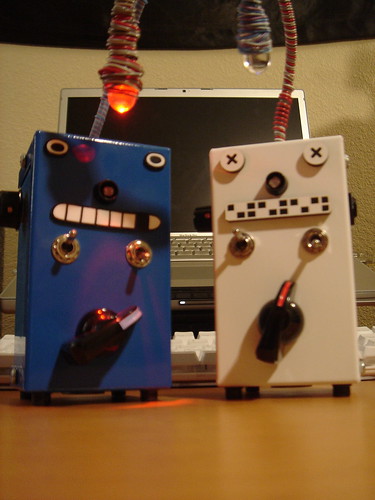
I already had one Thingamagoop, but when I saw the special Halloween editions, I couldn't help myself.
Not only do I now have a special edition Thingamagoop, but I now have a different sounding one. Yes, they sound different and compliment each other quite nicely. I've had a lot of fun so far making each one self modulate the other.
I'll probably draw the line at 2...unless more special editions come along. I'm a bit of a sucker for special editions.
Thursday, October 11, 2007
Plan B Model 15 Arrives
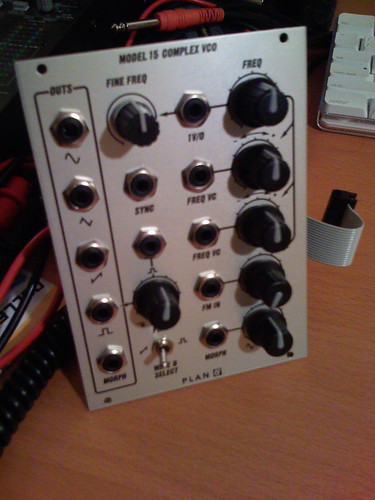
The Model 15 Arrives!!! My first oscillator that can track 1v/Oct. Color me ecstatic.
First off, let me say how bad ass Analogue Haven is. Shawn and Chuck and everyone there are the most incredible and nicest guys. I have always had a warm fuzzy feeling inside after giving them money; and it wasn't just because that meant gear was coming my way. If you are not currently giving them money, you should be. Shawn, you are the man!
Ok, so I've only played with it for a few hours last night, so the following is early impressions.
PWM. I see what people are griping about now. The "usable" pulse width range on the knob is pretty small. It's like from 10 - 2 o'clock on the knob, any further on the knob and the sound cuts out, presumably from the pulse being so small. HOWEVER, I completely see why Peter kept this feature. The sound that it makes as the pulse goes from really thin to kate moss thin sounds REALLY cool! It reminds me a bit of some of the sounds that Metasonix modules can make with the right knob settings. I think this feature of the Model 15 is very cool and really makes it stand out of the crowd. It's not your standard PWM, and I really like that. Personally, it would be nicer if it was spread out on the range of the knob a little more, like say 8 - 4 oclock. I don't mind the "dead" spots, just wish they were smaller.
Sync. I particularly like this Sync sound. I know people have complained it's not hard sync, but it has a unique character that is a nice timbral alternative. I have similar feeling towards it as I do the unique PWM; it's not the "standard" sound, but I like it. If you need the "standard" sound, get another VCO and now you have double the possibilities. Or for those who need to have a module that does everything; the Model 15A Expander sounds like it will clear up people's grips with PWM and Sync.
Waveforms. Holy waveshaping batman, these waveforms sound awesome! Granted, I don't have a lot of experience with the various available modular format oscillators, but I have played a lot of both analog and digital synths and I must say that this has the coolest sounding triangle wave I've ever heard. Normally, I hate triangle waves. To me they always sounded overly dull, almost as if something was not working correctly. It was like the inbred cousin of the sine and saw waves. In fact, I only listened to the triangle wave in this case because I accidentally plugged it in when I wanted to hear the sawtooth! Lucky me! Maybe the reason it has such a nice triangle is because it's the core waveform for the VCO. I don't know for sure, I just know I like it!
The sine wave is also incredible. It's very clean and loud, with the slightest touch of character. The sawtooth is still my favorite though. It's very "woody" and "organic" sounding. It pairs up perfectly with the Model 13 low pass gates for beautiful pluck sounds.
Bipolar Attenuators. I love bipolar attenuators. Love them. The only gripe I have about them is that very few modules (none actually to my knowledge) have knobs with detents at 0. This makes it very hard to actually have full attenuation (aka "0"), it's always a little positive or a little negative. This is especially true on the Model 15's Freq CV inputs because they are so sensitive. It's pretty difficult to actually have a CV patched in and have the knob set to 0; not without extremely gentle tweaking. You're not going to be able to turn it up during a performance and get it back to where it was very easily. This isn't really a problem with the Model 15 itself per se, more of a general problem with bipolar attenuators with non-detented knobs. And furthermore, maybe it's just me who gets a little bugged by this.
Morph Output. Man this is cool! I really dig the Sine - Saw morph, it's like another flavor of a PWM sound, but more unique sounding. Blending this output with the sawtooth outputs leads to some cool timbres; likewise doing Sine - Square and combining that with the square wave out. Audio rate modulation enhances this. Use of an envelop makes for a very cool "evolving sound".
Overall, this gets a glowing review from me. 2 thumbs up, if I had a third hand, I have that thumb up too. :D
I do plan on making a video demo, however, I want to spend more time with the module so that I really know it well before doing the demo. I'll also see about getting a loaner 15A Expander so that can be included in the demo since I bet a lot of people are going to want to see that as well.
Wednesday, October 10, 2007
Hardware Hacking

I've always been interested in electronics and how they work, but whenever I would decide to actually try and learn about schematics or whatever, the particular information source was always too "clinical" or assumed that I knew more basic fundamentals than did. Long story short, I always walked away going "ahhh, fuck it".
Since getting interested in modular synthesis I've been able to understand some of the more abstract fundamentals and concepts to general electronics. Also, through the brain-picking of colleagues I've been able to have a general idea of what resisters did, what capacitors did, etc. I still wasn't able to actually look at a schematic and understand what it was.
So I had been looking for ultimate beginners books that went about teaching through application; ie. making something, not just explaining everything like a spec sheet.
At AH Bay Area, I won a copy of the "Best of Analog Dialog" book which was a compilation of various application examples using Analog Devices ICs. I thought I finally had exactly what I was looking for... But, my heart sank when I started to dive into it and once again was saying to myself, "ahhh, fuck it".
Fast forward to the most recent TapeOp (no. 61 Sept/Oct 2007) and an interview with Nicolas Collins. Nicolas Collins is an "electronic musician" and teacher at The School of the Art Institute in Chicago. His book, Handmade Electronic Music: The Art of Hardware Hacking, is essentially based on his course of creating, modifying, and otherwise "abusing" electronic devices in order to make sound. Basically, it's like old school circuit bending (it's not exclusive to electronic toys) with a healthy dose of circuit design.
I must say, this book is absolutely brilliant. It's not written like a typical course book (in fact I wouldn't have known it was based on course material had I not actually read the intro) and it does not delve into great deal about general electronics or "engineering", it just gets right into actually making something.
Some fantastic examples are wiring up tape heads from cassette recorders or answering machines and swiping them over credit cards. Or making a piezo microphone and dipping it in "Plasti-Dip" (a plastic normally used to coat hand tools) so that it is water proof and usable to record under water, or even the sound of water freezing / ice melting!
By far my favorite part (thus far, I haven't even gotten half way through) was using a cheap CMOS inverter chip to create several square wave oscillators. He didn't actually explain schematics until you had a working circuit on a breadboard (with actual photos). I can now actually say that I understand many aspects of schematics now thanks to this. The way he will show you a modification to the circuit (swapping a resister for a potentiometer) with a real picture and then with the schematic representation made prefect sense and allowed me to better understand what the schematic meant. A picture is worth a thousand words, after all.
So anyway, long post short, go by this book. It's awesome. I already have several ideas for cool little instruments that I want to make, AND thanks to this book I feel like I can actually make them. Thank you Nicolas Collins!!!
Now I might actually understand what that Analog Dialog book is talking about after all. :D
Tuesday, October 09, 2007
Recent pictures of the modular
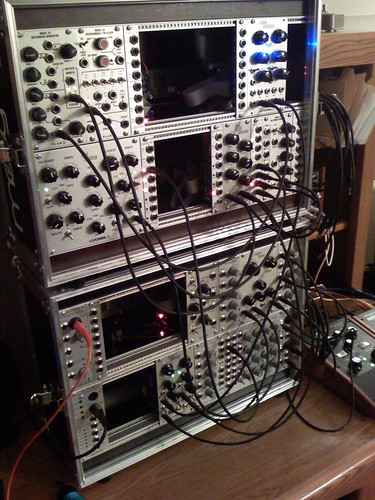
>>>
It's hard to believe, but I haven't actually taken a picture of the modules all racked up before! :/
So here it is, in all it's glory. You'll no doubt notice these somewhat strategically placed holes. From top to bottom, left to right, they will be filled as follows:
Livewire Chaos Computer (not yet released)
Livewire Vulcan Expansion selector thingy (not yet released)
Plan B Model 14 Voltage Processor
Livewire Audio Frequency Generator (aka 'AFG', not yet released)
Plan B Model 15 Complex VCO (ordered and in transit)
Pretty different than the original "mock up" images from way back when. I hadn't even really planned a 2nd case at that point and now I'm already debating how I'm going to handle further expansion. Muff was right, it truly never ends.
Oh, coincidentally, this shot is of the patch I posted about last night; DalekInvasion. Kinda hard to see cause the shot was taken with my phone, but might help if any of you were having a hard time visualizing what I was explaining.
Monday, October 08, 2007
DalekInvasion
This track is more interesting as far as the patch goes than it actually sounds, but I wanted to share anyway...
The main sound source is one square wave oscillator from the Dalek Modulator. It's pitch modulation comes from two sources:
The first is the "stepped" output of the Model 24 Heisenberg, which is paced by one square wave LFO from the Vulcan Modulator, and fed through one half of a Livewire Dual Bissell Generator (slew limiter).
The second source is the other square wave oscillator from the Dalek Modulator, set in Low range and run through the other half of the Dual Bissell Generator. The rate of this oscillator is modulated by the other square wave LFO from the Vulcan Modulator.
Both of these sources are then fed into a Doepfer A-150 Dual Voltage Controlled Switch (only using one of the switches). The switch is controlled by the Model 28 Tap Clock. Every time the quarter note gate is output, it causes the A-150 switch to change from using the first modulation source to using the second. So what you are hearing is the two modulation sources "trading off" every quarter note.
Beyond that, the "main output" of the Dual Cyclotron is modulating the filter cutoff. The Dual Cyclotron has become my favorite filter modulation source. There's something very organic and chaotic about it's modulation and that leads to some very cool timbres when used to modulate a filter (sparingly of course).
Finally, the output of the modular is going into a Moog MF-104 Analog Delay, with the Moog MF-102 Ring Modulator patched into the feedback loop. If you listen carefully, you can hear the delay repeats slowly get more "spacey" sounding. In some cases, it sounds like is almost slowly starting to play in reverse.
Enjoy.
The main sound source is one square wave oscillator from the Dalek Modulator. It's pitch modulation comes from two sources:
The first is the "stepped" output of the Model 24 Heisenberg, which is paced by one square wave LFO from the Vulcan Modulator, and fed through one half of a Livewire Dual Bissell Generator (slew limiter).
The second source is the other square wave oscillator from the Dalek Modulator, set in Low range and run through the other half of the Dual Bissell Generator. The rate of this oscillator is modulated by the other square wave LFO from the Vulcan Modulator.
Both of these sources are then fed into a Doepfer A-150 Dual Voltage Controlled Switch (only using one of the switches). The switch is controlled by the Model 28 Tap Clock. Every time the quarter note gate is output, it causes the A-150 switch to change from using the first modulation source to using the second. So what you are hearing is the two modulation sources "trading off" every quarter note.
Beyond that, the "main output" of the Dual Cyclotron is modulating the filter cutoff. The Dual Cyclotron has become my favorite filter modulation source. There's something very organic and chaotic about it's modulation and that leads to some very cool timbres when used to modulate a filter (sparingly of course).
Finally, the output of the modular is going into a Moog MF-104 Analog Delay, with the Moog MF-102 Ring Modulator patched into the feedback loop. If you listen carefully, you can hear the delay repeats slowly get more "spacey" sounding. In some cases, it sounds like is almost slowly starting to play in reverse.
Enjoy.
Clock divider "always on" trick
So I thought of also adding a category covering "tips and tricks" as I find them. Hopefully you all find them useful. Obviously some will be specific to certain modules, but hopefully some, like this one, will work probably work for any brand of similar functioning module.
I found that with the Doepfer A-160 Clock Divider, when it's powered on without a trigger source, several of the outputs will be "on", sending out a positive gate signal.
When I'm working on patches, a lot of time I want the main amp VCA to be open all the time until I get a patch to where I want it. Until recently, I would patch the output of the filter directly to the mixer, but this was usually more effort since the volume of the signal from the filter might be too loud, or I would have to re-patch a few things when it came time to use the VCA (and then re-adjust gain levels).
Now that I've discovered that the Clock Divider will output a constant "on" for several outputs, I just patch one of those directly to the gate input on the envelope controlling the main amp VCA. Then, once it's time to "play" the patch, I can just un-patch the cable from the Clock Divider into the Gate output from the keyboard and I'm ready to roll.
:D
I found that with the Doepfer A-160 Clock Divider, when it's powered on without a trigger source, several of the outputs will be "on", sending out a positive gate signal.
When I'm working on patches, a lot of time I want the main amp VCA to be open all the time until I get a patch to where I want it. Until recently, I would patch the output of the filter directly to the mixer, but this was usually more effort since the volume of the signal from the filter might be too loud, or I would have to re-patch a few things when it came time to use the VCA (and then re-adjust gain levels).
Now that I've discovered that the Clock Divider will output a constant "on" for several outputs, I just patch one of those directly to the gate input on the envelope controlling the main amp VCA. Then, once it's time to "play" the patch, I can just un-patch the cable from the Clock Divider into the Gate output from the keyboard and I'm ready to roll.
:D
The new look...and polls!
As you may have noticed, I took the time yesterday to update to the newer post-google Blogger templates. I mainly wanted to do this to try out adds (I'm not selling out or anything, I'm just curious on how much, if any, money that might bring in), but also mainly to add a Poll.
The first poll is in regards to the next demo video, it's on the right-hand side of the main page. Please vote so I can get a general idea of what you guys want to see next in terms of modules.
Thanks everyone!
The first poll is in regards to the next demo video, it's on the right-hand side of the main page. Please vote so I can get a general idea of what you guys want to see next in terms of modules.
Thanks everyone!
Sunday, October 07, 2007
Vulcan Modulator Demo
I feel like a right ass for not posting in so long. Work has been a bit busy and beyond that I've just been too lazy for my own good.
In effort to make amends, I bring you the Livewire Vulcan Modulator demo.
Enjoy.
In effort to make amends, I bring you the Livewire Vulcan Modulator demo.
Enjoy.
Saturday, September 15, 2007
Busy weekend, no synth fun
This weekend (and week actually) has been usually busy and I unfortunately do not have time to work on a new video. In fact I still haven't unpacked my rig since AH Bay Area last weekend :(
I did get around to playing with the Boss DS-1 that I won in the raffle; I forgot how cool those are. I guess I've become a bit jaded, not expecting a $40 pedal to be that good.
Speaking of AH Bay Area, the idea of putting together some kind of touch controller for the modular has constantly been on my mind since then. Ive wanted a Haken Continuum for a few years now but as I invest more and more money into modules, the price of a Continuum becomes harder and harder to swallow. That being said, I'd love to have some kind of Buchla-like touch controller. The best idea I've thought of is a 2 octave arrangement of short ribbon controllers arranged like keys of a standard kwyboard. That way you have some control fo up/down as well as pitch and trigger. Maybe even add a long ribbon along the bottom for a third control source; could be utilized by your thumb while your fingers are on the ribbon "keys".
What do you guys think?
I did get around to playing with the Boss DS-1 that I won in the raffle; I forgot how cool those are. I guess I've become a bit jaded, not expecting a $40 pedal to be that good.
Speaking of AH Bay Area, the idea of putting together some kind of touch controller for the modular has constantly been on my mind since then. Ive wanted a Haken Continuum for a few years now but as I invest more and more money into modules, the price of a Continuum becomes harder and harder to swallow. That being said, I'd love to have some kind of Buchla-like touch controller. The best idea I've thought of is a 2 octave arrangement of short ribbon controllers arranged like keys of a standard kwyboard. That way you have some control fo up/down as well as pitch and trigger. Maybe even add a long ribbon along the bottom for a third control source; could be utilized by your thumb while your fingers are on the ribbon "keys".
What do you guys think?
Sunday, September 09, 2007
Analogue Haven Bay Area 2007
AH BA was fucking awesome! I had *a lot* of fun and even managed to walk away with two raffle prizes; Best Of Analog Dialog magazine and a Boss DS-1 distortion (something I was planning on buying).
I also got to meet and talk to some really cool people. Eric from Metasonix was there, as was Paul Schreiber from MOTM. Dave Smith even showed up with a Prophet '08 which sounded sick and thick as hell. If anyone is in the market for a analog poly-synth, look no further than the Prophet '08! Zerosum also made the trip out and it was really cool to meet and hang out with him in real life. We need to do that again bro!
I was really pleased with the attention that my rig received; people generally thought it was pretty cool and a nice choice of modules. There were some *amazing* rigs there though. A huge Wiard system, Robert Rich's MOTM system, and Brandon Daniel's big Eurorack rig. There was also a big dot com system, I forgot that guys same (sorry to whoever you are). I was setup next to Chris Muir and his 200e rig; that was sweet!
All in all it was an awesome, awesome time; kudos to Gino and Brandon, and whoever else helped to organize the get together. Cheers guys, I can't wait until next year!
PS. I completely forgot to make use of the camera phone that was in my pocket the whole time, but there were a few folks there with still and video cameras, so I'm sure you'll be seeing coverage on Flickr + youTube soon.
[UPDATE]
From the AH list: Pictures from AHBA 2007.
There's a couple shots of me and my system on Page 2; just look for the Metasonix boxes ;)
I also got to meet and talk to some really cool people. Eric from Metasonix was there, as was Paul Schreiber from MOTM. Dave Smith even showed up with a Prophet '08 which sounded sick and thick as hell. If anyone is in the market for a analog poly-synth, look no further than the Prophet '08! Zerosum also made the trip out and it was really cool to meet and hang out with him in real life. We need to do that again bro!
I was really pleased with the attention that my rig received; people generally thought it was pretty cool and a nice choice of modules. There were some *amazing* rigs there though. A huge Wiard system, Robert Rich's MOTM system, and Brandon Daniel's big Eurorack rig. There was also a big dot com system, I forgot that guys same (sorry to whoever you are). I was setup next to Chris Muir and his 200e rig; that was sweet!
All in all it was an awesome, awesome time; kudos to Gino and Brandon, and whoever else helped to organize the get together. Cheers guys, I can't wait until next year!
PS. I completely forgot to make use of the camera phone that was in my pocket the whole time, but there were a few folks there with still and video cameras, so I'm sure you'll be seeing coverage on Flickr + youTube soon.
[UPDATE]
From the AH list: Pictures from AHBA 2007.
There's a couple shots of me and my system on Page 2; just look for the Metasonix boxes ;)
Monday, September 03, 2007
Model 28 Video Demo
It's Labor Day, I have the day off, and nothing really to do...so that means....video demo!
This time it's the Plan B Model 28 Programmable Tap Clock, per request. I tried to make it somewhat brief, but I still can't seem to make it under the 5 min mark.
Enjoy.
Addendum from Peter @ Plan B (via comments on Matrixsynth):
Regarding the separate START/STOP inputs:
Doing it with two inputs instead of one is a flashback from my Buchla days. My feeling it's better this way as you can if you wish use separate signals to start and stop the counting. This way you could for instance use a keyboard trigger to start it, which would also be used to start a sequencer and reset that seq to stage 1. Then you could use the gate output of let's say stage eight of that sequencer to stop the M28. This way you can get repeated eight beat phrases from the 28 which would begin on the depression of a keyboard. It would be much harder to do that with a single start/stop input.
-P
This time it's the Plan B Model 28 Programmable Tap Clock, per request. I tried to make it somewhat brief, but I still can't seem to make it under the 5 min mark.
Enjoy.
Addendum from Peter @ Plan B (via comments on Matrixsynth):
Regarding the separate START/STOP inputs:
Doing it with two inputs instead of one is a flashback from my Buchla days. My feeling it's better this way as you can if you wish use separate signals to start and stop the counting. This way you could for instance use a keyboard trigger to start it, which would also be used to start a sequencer and reset that seq to stage 1. Then you could use the gate output of let's say stage eight of that sequencer to stop the M28. This way you can get repeated eight beat phrases from the 28 which would begin on the depression of a keyboard. It would be much harder to do that with a single start/stop input.
-P
Monday, August 27, 2007
Sad news
I just read about the passing of Daniel Hansson, co-founder of Elektron and designer of the SidStation, MachineDrum, and MonoMachine. He apparently died as a result of a car accident. He was only 33.
It's very odd, I was just thinking about making a post about my MachineDrum, which is an incredible piece of gear and one of my favorite items, prior to reading this.
My condolences go out to everyone @ Elektron and of course, Daniel's family.
I think a session with the MachineDrum tonight is required in memorial.
It's very odd, I was just thinking about making a post about my MachineDrum, which is an incredible piece of gear and one of my favorite items, prior to reading this.
My condolences go out to everyone @ Elektron and of course, Daniel's family.
I think a session with the MachineDrum tonight is required in memorial.
Sunday, August 26, 2007
Dual Cyclotron Video Demo
The camera will still all setup this morning, so I thought I'd churn out a quick demo for the Dual Cyclotron.
Turned out to be not so quick; it's slightly longer than the Model 24 demo.
There is a correction necessary. During the video I mention that we're listing to the sine wave output of the Dalek Modulator...it was actually the square wave. :p
Enjoy.
Turned out to be not so quick; it's slightly longer than the Model 24 demo.
There is a correction necessary. During the video I mention that we're listing to the sine wave output of the Dalek Modulator...it was actually the square wave. :p
Enjoy.
Saturday, August 25, 2007
DalekAcapella
This patch came from a few tweaks to the final patch I did in the Model 24 video demo.
The Model 24 Stepped output is modulating the frequency of the Dalek Modulator's carrier oscillator. It turns out there is some cross-talk between the Carrier and Modulator oscillators if one of them is in High freq mode and the other is in Low; that's what's causing the vibrato that you hear. This vibrato frequency from the Modulator is being modulated in turn by the Dual Cyclotron.
The output of the Dalek is going through the Frequensteiner, which is being modulated by the MIN output of the Vulcan Modulator, making little filter sweeps.
The main VCA is being opened by a Model 10 EG, which is being triggered by the eight note output of the Model 28 Tap Clock. The Time-Base of the Attack and Decay is being modulated by the Smooth output of the Model 24. The End-of-Cycle trigger output of the Model 10 is triggering the next random voltage value on the Model 24.
What I find particularly cool about this patch is that a lot of it's characteristics are due to "quirky" behavior of a few of the modules. Specifically, the cross-talk between the two oscillators in the Dalek (causing the vibrato) as well as the fact that the Model 10 does not re-trigger until the Attack and Decay cycles have finished. It's because of this that the Model 10 is not being re-triggered on every eighth note pulse that comes out of the Model 28 Tap Clock. This, combined with the modulated Time-Based of the Attack and Decay, makes it sound very natural, almost as if someone were singing; holding some notes longer than others.
:D
Enjoy.
The Model 24 Stepped output is modulating the frequency of the Dalek Modulator's carrier oscillator. It turns out there is some cross-talk between the Carrier and Modulator oscillators if one of them is in High freq mode and the other is in Low; that's what's causing the vibrato that you hear. This vibrato frequency from the Modulator is being modulated in turn by the Dual Cyclotron.
The output of the Dalek is going through the Frequensteiner, which is being modulated by the MIN output of the Vulcan Modulator, making little filter sweeps.
The main VCA is being opened by a Model 10 EG, which is being triggered by the eight note output of the Model 28 Tap Clock. The Time-Base of the Attack and Decay is being modulated by the Smooth output of the Model 24. The End-of-Cycle trigger output of the Model 10 is triggering the next random voltage value on the Model 24.
What I find particularly cool about this patch is that a lot of it's characteristics are due to "quirky" behavior of a few of the modules. Specifically, the cross-talk between the two oscillators in the Dalek (causing the vibrato) as well as the fact that the Model 10 does not re-trigger until the Attack and Decay cycles have finished. It's because of this that the Model 10 is not being re-triggered on every eighth note pulse that comes out of the Model 28 Tap Clock. This, combined with the modulated Time-Based of the Attack and Decay, makes it sound very natural, almost as if someone were singing; holding some notes longer than others.
:D
Enjoy.
Model 24 Heisenberg Generator Demo
I finally got around to making another video demo...hopefully it won't be as long until the next one.
Enjoy.
[update] I had to re-upload the video...the first video didn't have any audio...because I'm retarded and had it off in the export settings.
Enjoy.
[update] I had to re-upload the video...the first video didn't have any audio...because I'm retarded and had it off in the export settings.
Saturday, August 11, 2007
TehSpooky
This is a patch I did last night while using the Plan B Model 24 in a traditional S+H configuration. The sample voltage was coming from the Dual Cyclotron and the clock was from the 8th note output of the Model 28 Tap Clock; this S+H voltage is controlling the pitch of the carrier on the Dalek Modulator (the modulator is a slower smoothed square wave...giving that tremolo effect). The 1/4 note output of the Model 28 is opening the master amplitude VCA, so in effect what you hear is two changes in pitch each time the VCA opens.
I think the Model 10 EG was used to sweep the filter too...I can't remember now that I took the patch apart :p
Enjoy.
I think the Model 10 EG was used to sweep the filter too...I can't remember now that I took the patch apart :p
Enjoy.
Tuesday, August 07, 2007
Model 28 problem
When I got my Model 28, I noticed that the Select input didn't seem to be working correctly. At the time I figured the voltage I was putting into it wasn't the scale that it wanted and reminded myself to check it out later (I was trying to have fun after all, not debug stuff).
Well, it turns out there is something wrong with it. Peter posted to the yahoo group notifying us that the first 15 units shipped with a mis-programmed microprocessor which handles the switching of pulses based on the voltage in the Select input.
Basically those of us with these Model 28s have to send back the microprocessor for re-programming. Not a huge deal I guess. Hopefully I'll be able to still use the other functions of the Model 28 without it...but I'm kinda doubting that.
Click the link above to see the post on the Yahoo group.
Well, it turns out there is something wrong with it. Peter posted to the yahoo group notifying us that the first 15 units shipped with a mis-programmed microprocessor which handles the switching of pulses based on the voltage in the Select input.
Basically those of us with these Model 28s have to send back the microprocessor for re-programming. Not a huge deal I guess. Hopefully I'll be able to still use the other functions of the Model 28 without it...but I'm kinda doubting that.
Click the link above to see the post on the Yahoo group.
Monday, August 06, 2007
correction
I just wanted to post a correction on what I said about the Doepfer A-105 SSM LP filter in my last post. It doesn't use a Curtis (CEM) chip, but rather the SSM2044 (you would have thought that obvious huh?).
Anyway, it was used in the early Prophets as well as in the Mono/Poly (one of my faves), it's just not a Curtis chip. I had thought the Sequential stuff had always used the CEM chips, but that apparently wasn't until later.
If you click the product link above, you'll get the full rundown.
In other, yet related, news, I believe this is my new favorite filter, at least for LP. I certainly like it's character for traditional LP sounds more than the FrequenSteiner. I'm going to reserve final judgment until I have some saw waves to run through them both, but so far the SSM wins for LP sounds (the FrequenSteiner still has some of the meanest BP and HP sounds I've heard).
Anyway, it was used in the early Prophets as well as in the Mono/Poly (one of my faves), it's just not a Curtis chip. I had thought the Sequential stuff had always used the CEM chips, but that apparently wasn't until later.
If you click the product link above, you'll get the full rundown.
In other, yet related, news, I believe this is my new favorite filter, at least for LP. I certainly like it's character for traditional LP sounds more than the FrequenSteiner. I'm going to reserve final judgment until I have some saw waves to run through them both, but so far the SSM wins for LP sounds (the FrequenSteiner still has some of the meanest BP and HP sounds I've heard).
Subscribe to:
Posts (Atom)

