Wednesday, October 10, 2007

Hardware Hacking


I've always been interested in electronics and how they work, but whenever I would decide to actually try and learn about schematics or whatever, the particular information source was always too "clinical" or assumed that I knew more basic fundamentals than did. Long story short, I always walked away going "ahhh, fuck it".

Since getting interested in modular synthesis I've been able to understand some of the more abstract fundamentals and concepts to general electronics. Also, through the brain-picking of colleagues I've been able to have a general idea of what resisters did, what capacitors did, etc. I still wasn't able to actually look at a schematic and understand what it was.

So I had been looking for ultimate beginners books that went about teaching through application; ie. making something, not just explaining everything like a spec sheet.
At AH Bay Area, I won a copy of the "Best of Analog Dialog" book which was a compilation of various application examples using Analog Devices ICs. I thought I finally had exactly what I was looking for... But, my heart sank when I started to dive into it and once again was saying to myself, "ahhh, fuck it".

Fast forward to the most recent TapeOp (no. 61 Sept/Oct 2007) and an interview with Nicolas Collins. Nicolas Collins is an "electronic musician" and teacher at The School of the Art Institute in Chicago. His book, Handmade Electronic Music: The Art of Hardware Hacking, is essentially based on his course of creating, modifying, and otherwise "abusing" electronic devices in order to make sound. Basically, it's like old school circuit bending (it's not exclusive to electronic toys) with a healthy dose of circuit design.

I must say, this book is absolutely brilliant. It's not written like a typical course book (in fact I wouldn't have known it was based on course material had I not actually read the intro) and it does not delve into great deal about general electronics or "engineering", it just gets right into actually making something.

Some fantastic examples are wiring up tape heads from cassette recorders or answering machines and swiping them over credit cards. Or making a piezo microphone and dipping it in "Plasti-Dip" (a plastic normally used to coat hand tools) so that it is water proof and usable to record under water, or even the sound of water freezing / ice melting!

By far my favorite part (thus far, I haven't even gotten half way through) was using a cheap CMOS inverter chip to create several square wave oscillators. He didn't actually explain schematics until you had a working circuit on a breadboard (with actual photos). I can now actually say that I understand many aspects of schematics now thanks to this. The way he will show you a modification to the circuit (swapping a resister for a potentiometer) with a real picture and then with the schematic representation made prefect sense and allowed me to better understand what the schematic meant. A picture is worth a thousand words, after all.

So anyway, long post short, go by this book. It's awesome. I already have several ideas for cool little instruments that I want to make, AND thanks to this book I feel like I can actually make them. Thank you Nicolas Collins!!!

Now I might actually understand what that Analog Dialog book is talking about after all. :D

Tuesday, October 09, 2007

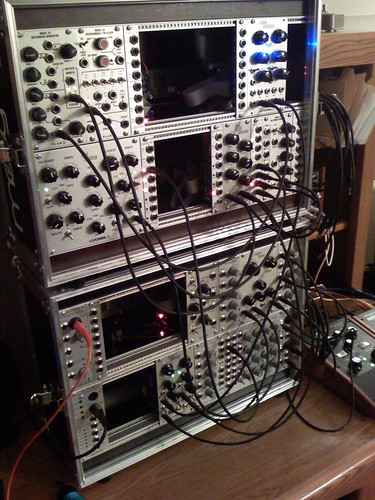
Recent pictures of the modular


>>>
It's hard to believe, but I haven't actually taken a picture of the modules all racked up before! :/

So here it is, in all it's glory. You'll no doubt notice these somewhat strategically placed holes. From top to bottom, left to right, they will be filled as follows:

Livewire Chaos Computer (not yet released)
Livewire Vulcan Expansion selector thingy (not yet released)
Plan B Model 14 Voltage Processor
Livewire Audio Frequency Generator (aka 'AFG', not yet released)
Plan B Model 15 Complex VCO (ordered and in transit)

Pretty different than the original "mock up" images from way back when. I hadn't even really planned a 2nd case at that point and now I'm already debating how I'm going to handle further expansion. Muff was right, it truly never ends.

Oh, coincidentally, this shot is of the patch I posted about last night; DalekInvasion. Kinda hard to see cause the shot was taken with my phone, but might help if any of you were having a hard time visualizing what I was explaining.

Monday, October 08, 2007

DalekInvasion

This track is more interesting as far as the patch goes than it actually sounds, but I wanted to share anyway...

The main sound source is one square wave oscillator from the Dalek Modulator. It's pitch modulation comes from two sources:

The first is the "stepped" output of the Model 24 Heisenberg, which is paced by one square wave LFO from the Vulcan Modulator, and fed through one half of a Livewire Dual Bissell Generator (slew limiter).

The second source is the other square wave oscillator from the Dalek Modulator, set in Low range and run through the other half of the Dual Bissell Generator. The rate of this oscillator is modulated by the other square wave LFO from the Vulcan Modulator.

Both of these sources are then fed into a Doepfer A-150 Dual Voltage Controlled Switch (only using one of the switches). The switch is controlled by the Model 28 Tap Clock. Every time the quarter note gate is output, it causes the A-150 switch to change from using the first modulation source to using the second. So what you are hearing is the two modulation sources "trading off" every quarter note.

Beyond that, the "main output" of the Dual Cyclotron is modulating the filter cutoff. The Dual Cyclotron has become my favorite filter modulation source. There's something very organic and chaotic about it's modulation and that leads to some very cool timbres when used to modulate a filter (sparingly of course).

Finally, the output of the modular is going into a Moog MF-104 Analog Delay, with the Moog MF-102 Ring Modulator patched into the feedback loop. If you listen carefully, you can hear the delay repeats slowly get more "spacey" sounding. In some cases, it sounds like is almost slowly starting to play in reverse.


Enjoy.

Clock divider "always on" trick

So I thought of also adding a category covering "tips and tricks" as I find them. Hopefully you all find them useful. Obviously some will be specific to certain modules, but hopefully some, like this one, will work probably work for any brand of similar functioning module.

I found that with the Doepfer A-160 Clock Divider, when it's powered on without a trigger source, several of the outputs will be "on", sending out a positive gate signal.

When I'm working on patches, a lot of time I want the main amp VCA to be open all the time until I get a patch to where I want it. Until recently, I would patch the output of the filter directly to the mixer, but this was usually more effort since the volume of the signal from the filter might be too loud, or I would have to re-patch a few things when it came time to use the VCA (and then re-adjust gain levels).

Now that I've discovered that the Clock Divider will output a constant "on" for several outputs, I just patch one of those directly to the gate input on the envelope controlling the main amp VCA. Then, once it's time to "play" the patch, I can just un-patch the cable from the Clock Divider into the Gate output from the keyboard and I'm ready to roll.

:D

The new look...and polls!

As you may have noticed, I took the time yesterday to update to the newer post-google Blogger templates. I mainly wanted to do this to try out adds (I'm not selling out or anything, I'm just curious on how much, if any, money that might bring in), but also mainly to add a Poll.

The first poll is in regards to the next demo video, it's on the right-hand side of the main page. Please vote so I can get a general idea of what you guys want to see next in terms of modules.

Thanks everyone!

Sunday, October 07, 2007

Vulcan Modulator Demo

I feel like a right ass for not posting in so long. Work has been a bit busy and beyond that I've just been too lazy for my own good.

In effort to make amends, I bring you the Livewire Vulcan Modulator demo.


Enjoy.

Saturday, September 15, 2007

Busy weekend, no synth fun

This weekend (and week actually) has been usually busy and I unfortunately do not have time to work on a new video. In fact I still haven't unpacked my rig since AH Bay Area last weekend :(

I did get around to playing with the Boss DS-1 that I won in the raffle; I forgot how cool those are. I guess I've become a bit jaded, not expecting a $40 pedal to be that good.

Speaking of AH Bay Area, the idea of putting together some kind of touch controller for the modular has constantly been on my mind since then. Ive wanted a Haken Continuum for a few years now but as I invest more and more money into modules, the price of a Continuum becomes harder and harder to swallow. That being said, I'd love to have some kind of Buchla-like touch controller. The best idea I've thought of is a 2 octave arrangement of short ribbon controllers arranged like keys of a standard kwyboard. That way you have some control fo up/down as well as pitch and trigger. Maybe even add a long ribbon along the bottom for a third control source; could be utilized by your thumb while your fingers are on the ribbon "keys".

What do you guys think?

Sunday, September 09, 2007

Analogue Haven Bay Area 2007

AH BA was fucking awesome! I had *a lot* of fun and even managed to walk away with two raffle prizes; Best Of Analog Dialog magazine and a Boss DS-1 distortion (something I was planning on buying).

I also got to meet and talk to some really cool people. Eric from Metasonix was there, as was Paul Schreiber from MOTM. Dave Smith even showed up with a Prophet '08 which sounded sick and thick as hell. If anyone is in the market for a analog poly-synth, look no further than the Prophet '08! Zerosum also made the trip out and it was really cool to meet and hang out with him in real life. We need to do that again bro!

I was really pleased with the attention that my rig received; people generally thought it was pretty cool and a nice choice of modules. There were some *amazing* rigs there though. A huge Wiard system, Robert Rich's MOTM system, and Brandon Daniel's big Eurorack rig. There was also a big dot com system, I forgot that guys same (sorry to whoever you are). I was setup next to Chris Muir and his 200e rig; that was sweet!

All in all it was an awesome, awesome time; kudos to Gino and Brandon, and whoever else helped to organize the get together. Cheers guys, I can't wait until next year!

PS. I completely forgot to make use of the camera phone that was in my pocket the whole time, but there were a few folks there with still and video cameras, so I'm sure you'll be seeing coverage on Flickr + youTube soon.

[UPDATE]
From the AH list: Pictures from AHBA 2007.

There's a couple shots of me and my system on Page 2; just look for the Metasonix boxes ;)

Monday, September 03, 2007

Model 28 Video Demo

It's Labor Day, I have the day off, and nothing really to do...so that means....video demo!

This time it's the Plan B Model 28 Programmable Tap Clock, per request. I tried to make it somewhat brief, but I still can't seem to make it under the 5 min mark.


Enjoy.

Addendum from Peter @ Plan B (via comments on Matrixsynth):

Regarding the separate START/STOP inputs:
Doing it with two inputs instead of one is a flashback from my Buchla days. My feeling it's better this way as you can if you wish use separate signals to start and stop the counting. This way you could for instance use a keyboard trigger to start it, which would also be used to start a sequencer and reset that seq to stage 1. Then you could use the gate output of let's say stage eight of that sequencer to stop the M28. This way you can get repeated eight beat phrases from the 28 which would begin on the depression of a keyboard. It would be much harder to do that with a single start/stop input.

-P

Monday, August 27, 2007

Sad news

I just read about the passing of Daniel Hansson, co-founder of Elektron and designer of the SidStation, MachineDrum, and MonoMachine. He apparently died as a result of a car accident. He was only 33.

It's very odd, I was just thinking about making a post about my MachineDrum, which is an incredible piece of gear and one of my favorite items, prior to reading this.

My condolences go out to everyone @ Elektron and of course, Daniel's family.

I think a session with the MachineDrum tonight is required in memorial.

Sunday, August 26, 2007

Dual Cyclotron Video Demo

The camera will still all setup this morning, so I thought I'd churn out a quick demo for the Dual Cyclotron.

Turned out to be not so quick; it's slightly longer than the Model 24 demo.

There is a correction necessary. During the video I mention that we're listing to the sine wave output of the Dalek Modulator...it was actually the square wave. :p


Enjoy.

Saturday, August 25, 2007

DalekAcapella

This patch came from a few tweaks to the final patch I did in the Model 24 video demo.

The Model 24 Stepped output is modulating the frequency of the Dalek Modulator's carrier oscillator. It turns out there is some cross-talk between the Carrier and Modulator oscillators if one of them is in High freq mode and the other is in Low; that's what's causing the vibrato that you hear. This vibrato frequency from the Modulator is being modulated in turn by the Dual Cyclotron.

The output of the Dalek is going through the Frequensteiner, which is being modulated by the MIN output of the Vulcan Modulator, making little filter sweeps.

The main VCA is being opened by a Model 10 EG, which is being triggered by the eight note output of the Model 28 Tap Clock. The Time-Base of the Attack and Decay is being modulated by the Smooth output of the Model 24. The End-of-Cycle trigger output of the Model 10 is triggering the next random voltage value on the Model 24.

What I find particularly cool about this patch is that a lot of it's characteristics are due to "quirky" behavior of a few of the modules. Specifically, the cross-talk between the two oscillators in the Dalek (causing the vibrato) as well as the fact that the Model 10 does not re-trigger until the Attack and Decay cycles have finished. It's because of this that the Model 10 is not being re-triggered on every eighth note pulse that comes out of the Model 28 Tap Clock. This, combined with the modulated Time-Based of the Attack and Decay, makes it sound very natural, almost as if someone were singing; holding some notes longer than others.

:D


Enjoy.

Model 24 Heisenberg Generator Demo

I finally got around to making another video demo...hopefully it won't be as long until the next one.


Enjoy.

[update] I had to re-upload the video...the first video didn't have any audio...because I'm retarded and had it off in the export settings.

Saturday, August 11, 2007

TehSpooky

This is a patch I did last night while using the Plan B Model 24 in a traditional S+H configuration. The sample voltage was coming from the Dual Cyclotron and the clock was from the 8th note output of the Model 28 Tap Clock; this S+H voltage is controlling the pitch of the carrier on the Dalek Modulator (the modulator is a slower smoothed square wave...giving that tremolo effect). The 1/4 note output of the Model 28 is opening the master amplitude VCA, so in effect what you hear is two changes in pitch each time the VCA opens.

I think the Model 10 EG was used to sweep the filter too...I can't remember now that I took the patch apart :p

Enjoy.

Tuesday, August 07, 2007

Model 28 problem

When I got my Model 28, I noticed that the Select input didn't seem to be working correctly. At the time I figured the voltage I was putting into it wasn't the scale that it wanted and reminded myself to check it out later (I was trying to have fun after all, not debug stuff).

Well, it turns out there is something wrong with it. Peter posted to the yahoo group notifying us that the first 15 units shipped with a mis-programmed microprocessor which handles the switching of pulses based on the voltage in the Select input.

Basically those of us with these Model 28s have to send back the microprocessor for re-programming. Not a huge deal I guess. Hopefully I'll be able to still use the other functions of the Model 28 without it...but I'm kinda doubting that.

Click the link above to see the post on the Yahoo group.

Monday, August 06, 2007

correction

I just wanted to post a correction on what I said about the Doepfer A-105 SSM LP filter in my last post. It doesn't use a Curtis (CEM) chip, but rather the SSM2044 (you would have thought that obvious huh?).

Anyway, it was used in the early Prophets as well as in the Mono/Poly (one of my faves), it's just not a Curtis chip. I had thought the Sequential stuff had always used the CEM chips, but that apparently wasn't until later.

If you click the product link above, you'll get the full rundown.

In other, yet related, news, I believe this is my new favorite filter, at least for LP. I certainly like it's character for traditional LP sounds more than the FrequenSteiner. I'm going to reserve final judgment until I have some saw waves to run through them both, but so far the SSM wins for LP sounds (the FrequenSteiner still has some of the meanest BP and HP sounds I've heard).

Tuesday, July 31, 2007

New modules and "The Sword"

Many delays in my posts due to a sequence of things:
1) HP Deathly Hallows released
2) My Birthday (26 now)
3) Family in town to visit

Of course, right there between 2 and 3 I got the final "big" shipment of Modules from Analogue Haven. I say "big" because it was more than 1 or 2 modules (8 to be exact) and will likely be the last shipment of such a quantity. I still have a couple more modules to purchase, so it's not the last of the orders...just the last of the "big" ones.

This order brought the Plan B Model 28 Tap Clock (fucking outstanding!), Plan B Model 10 Poly Env (super cool and a great alternative to regular EGs), Livewire Dalek Modulator (super sweet, and my first real oscillators, even if they don't track 1v/Oct), as well as some general Doepfer modules (A-138c Mixer, A-150 Voltage Control Switch, and A-160 Clock Divider). The final module, which I was overly surprised about was the Doepfer A-105 SSM LP Filter. This is basically a Curtis-based filter that is supposed to sound like the Prophet, Mono/Poly, anything that used a Curtis filter. I've never really experienced a Curtis filter before, so I didn't know exactly what it sounded like (it's always hard to tell how much a filter influences the character of a particular synth when it's built in), but it is really great sounding! The top end is nice and bitey without being harsh or gritty. It's a perfect complement to the FrequenSteiner! I'm really glad now that I decided to add a second filter, especially this one.

The Dalek Modulator is also very cool and I have really been enjoying having a real oscillator to play with. Gone are times of having to use the FrequenSteiner self-oscillate just to get an audio tone. The timbres that can come out of the Dalek are quite interesting and beyond what I expected, even with my experience with the Moog MF-102 ring mod. They certainly do each have their own sound. The fact that the ring mod section can be used independently of the oscillators is also very cool.

I know I'm incredibly behind on the video demos and I will get working on some very soon, but in the mean time, enjoy the following audio demo.

In this patch, the main "lead" sound is actually my guitar through an Effector-13 Soda Meiser with a fairly conservative setting being run through the Doepfer A-105 SSM LP filter which has it's cutoff frequency modulated by the Smooth output of the Plan B Heisenberg Generator. The signal is then run into a VCA being opened by an ADSR triggered at a 1/4 note (thanks to the Doepfer Clock divider and MIDI clock from MachineDrum)

Also running into that VCA (it has two audio inputs, each with atten) is the second audio source which is the Dalek Modulator Ring output. The Carrier is tuned to "E" and is not being modulated. The Modulator, however, is being fully modulated by a CV signal from the Livewire Dual Cycltron which is being attenuated through a VCA by the "Difference" output on the Vulcan Modulator. This is what is causing that rhythmic "shift" in timbre in the background.

The output of the modular+guitar then feeds into the Moog MF-104 analog delay with the Frostwave Resonator in the delay's feedback loop. This just gives the delay a more "tape" sound because each repeat gets a little more filtered and band-limited sounding. I was going to modulate this and get some dub-feedback stuff in there, but I got lazy.

The drums (and MIDI clock for the modular) are from the MachineDrum. Some of those sounds might be preset ones and others ones I programmed, but it's just a simple pattern. I really like the kick sound, it has a lot of attack so it's easy to hear on small speakers, but there is a lot of bass down on the bottom.

Enjoy.

Saturday, July 21, 2007

VCAs fucking rule!

Pretty self explanatory I guess, but months ago, when I was asking my friend Brandon about modulars. and just general advice on what kinds of modules to check out, he said "you'll want several VCAs". At the time I thought, "ok well I'll get an exponential one for the audio and a linear one for CV and that's all I need." For whatever reason, I didn't remember using VCAs very much at all when I had the Nord G2 and I think that lead to my bias. Well I'm certainly glad that I accidentally ordered an extra linear VCA (actually dual linear VCA) because I can't get enough of them. It's becoming that every time I pause to think "ok how can I get ..." I can do it with a VCA somehow. And of course, anytime you wish you had a 3rd, 4th, etc hand to tweak some knob...all you need is a VCA. Fucking rad.

modulars are cool

:D

Monday, July 16, 2007

what the frac!?

So I'm not even finished with my 2 case euro-rack modular and I already have seen some frac-rack format modules that "I absolutely must have".

Of course, once the euro-rack is finished, that might turn out to be a gross exaggeration, but as of right now that's where it stands. The modules also do not have a direct euro-rack equivalent, so that makes them all the more covet-worthy. Luckily I have not found more than 1 "frac rack" of modules that I would like, so I wouldn't be sinking a bunch of money into it like I have with the euro-rack. That's at least comforting as well as the fact that the rack/PSU for the frac format is *much* cheaper than it's euro-rack equivalent (although to be honest, looks more bulky and "janky" than the Doepfer cases).

The module that caught my eye the most was the Blacet Miniwave. Thanks to zerosum's many demos, it's the one that I'd happily buy the frac format case just to have this module. It's essentially a wave-rom lookup module but can achieve many things because of this. Quantizer, Oscillator, Fuzz, Wacky-ass-control-voltage-source, etc. There's also additional ROMs that can be purchases and each wave form is CV selectable in the bank. The only thing that comes close to this on euro that I know of is the Doepfer A-112 Wavetable Sampler/OSC and it doesn't seem anywhere near as versatile.

Secondly, the Blacet Binary Zone is a voltage pattern generator. It also has on-board lag processing and accepts internal clock. It makes some rad sounding control voltages and the only way that I can explain is it is to have you check out that product page and listen to the demos. I might be able to cook up something similar with several of my planned euro modules, but why not have one module that serves the same purpose. I love tempo-accurate random stuff so this is basically right up my alley.

The third module is the Wiard Noise Ring. This module is essentially a random voltage generator (ie sample + hold), however, it has logic to govern the frequency of drastic changes and how drastic the change is. Think of it as a more musical sample+hold. I think this would be a very interesting complement to my Plan B Model 24 (Heisenberg) as I consider it a very "musical" sample+hold.

There are also other interesting offerings particularly the Borg and Boogie filters from Wiard. These look cool and would certainly fill out the extra spaces of a frac chassis, but I'm most interested in the main three that I listed. I'm not one of those guys who needs every kind of variation of filter or oscillator, but I don't think I can pass up the unique functionality of the MiniWave, Binary Zone, and the Noise Ring. I also *REALLY* like the Wiard Woggle Bug, but that is not made in the frac format. As much as I want one, I can't justify investing in a 3rd format just for that...sure there are other rad 300 modules, but I'll just be carried away to the poor house; albeit with a fine soundtrack ;)

Either way, it's a long way out...both in time and money.

Monday, July 02, 2007

ah, sweet edification

I've been spending spare minutes with these new modules every chance I get and two in particular had me stumped on their internal operation. It's funny that I would discover the mystery of these two on the same day, both by accident.

The Plan B Heisenberg Generator and the Livewire Dual Cyclotron have been the proverbial enigma for me; the Dual Cyclotron particularly more than the Heisenberg. The Heisenberg I actually had pretty well figured out except for the relationship between the two "halves"; particularly the "Chaos" knob on the smoothed output half. The Dual Cyclotron I had basically no solid idea on...I mean, I kinda did, I could obviously hear how things changed, but I had no idea specifically what the various knobs actually did. Just turing knobs blindly is fun, but eventually you want to know what you're doing...it certainly makes recalling a cool sound a lot easier.

As I said, the Hesienberg wasn't that much of a mystery. The various knobs all have specific names which are very descriptive of their function. Mean, Deviation, CV control of these, etc. However, what I was confused about was the Chaos control, which, based on it's location, solely effected the Smooth (slew limited) random output half. What seemed very odd was that with Chaos set to 0, the Smooth output voltage did not seem to change at all; with the Chaos up high (2 o'clock +) the output voltage would be very erratic, "Chaos" even. ;)

Still, I couldn't tell exactly what it was doing. It seemed like Chaos controlled additional modulation of the sample and hold already clocked by the "Meter" knob at the bottom of the module, but then again, sometimes changing the "Meter" knob did not seem to alter the Smoothed output. Until today, I just chalked this behavior up to an "endearing quirkiness" of the module. While showing the product page to a colleague at work, I noticed a link to a block diagram of the module and how it integrates its Atmel 2051 Micro Controller. Of the 20 or so times I had studied this page before I bought the module, I never noticed this. It clearly indicates that the "Chaos" knob is the control for the LFO/Clock controlling the sample and hold for the Smooth output. It's basically the "Meter" knob's equivalent on the Smooth output half. Simple. :P

The Dual Cyclotron, however, was much more elusive. It has virtually no documentation, er, actually no documentation. The creative description of the module as a design taken from the Roswell spaceship crash wreckage is cute and adds some general character to the coolness of the thing, but it's far from helpful on indicating how the hell it does the cool shit it does.

As far as I got to figuring thing out was that there are 3 separate oscillators, two identical ones (presumably the "cyclotrons" and a 3rd oscillator which seemed to be the primary voltage output source. All 3 had "Symmetry" controls, just like the Vulcan Modulator, so I figured they did the same as on the Vulcan which is shift the positive peak of the waveform to either side of the center Y axis (like a pulse width, but for any waveform). It sounded like it did that too. The two cyclotrons each had speed range controls (selectable knob for "Stretched, Normal, and Compressed") and the main oscillator had a switch for LF (low freq) and AF (audio freq). Everything else I only had a vague idea on, and as I found out today, almost the completely wrong idea.

No less than 10 minutes after discovering the block diagram for the Heisenberg, I'm in the bathroom and notice an old copy of Electronic Musician which had a feature on analog modular synths by Gino Robair (June 2006). I had read this article before, but it was certainly more interesting than the dozen other articles in the magazines I have read multiple times in the bathroom. Low and behold, what do I find but a perfect and simple description of what each control on the Dual Cyclotron does!

It's a lot of info, and I understand the module a lot more now, so I want to save it for the video demo. Now I'm confident it's gonna be a good one. :D