So after witnessing my endless back-and-forth Buchla lust over the last several months (and really, it's gone on longer than that), I was extended an invitation to visit the venerable Chris Muir and his Buchla for an afternoon of enlightenment.
Since the Buchla lust had kicked up again as of late, I was bit worried about being exposed directly to a Buchla, but at the same time, I'm practically broke, so I wasn't that worried that I would phone up Don in the morning to place an order. I was anticipating it though.
What I got was something else.
First, the system is as visually striking in person as it is in pictures, this I knew, but after Chris turned up the speakers, I heard something I wasn't expecting. There is definitely something lost when listening to MP3s and possibly even WAV files (I can't remember how many of the demos that I have listened to have been WAVs). There is much more dimension to the sound when you're listening to it through speakers and the details of the sound are much more complex. What came across as almost noise in some MP3s, was a complex harmonic evolution of sound in real life. I'm not trying to be over dramatic, I was just surprised at the very quantifiable difference in hearing the Buchla in real life.
As Chris gave me a tour around his system, it was very interesting to see how he utilized modules in ways that never crossed my mind in the hours I had spent staring at the Buchla web pages and module images. It was equally as interesting to find out that many aspects of the modules worked differently than I understood them to. One thing that excited me was learning that the 291e filter was able to sequence through it's various stages on its own, without an external clock pulse. Each stage of the 291e has a editable time constant which determines the time until it switches to the next stage.
Speaking of the 291e, it was quite impressive. It's definitely not designed to be used as a "standard" synth filter; it's practically half a synthesizer+sequencer all its own. While it's bandpass only, it sounds incredible. It's very clean, clear, and "vocal" sounding, and with some applied audio-rate modulation, has an incredible growl. Listening to Chris make a quick sequence of the filter's stages, with different amounts of FM per stage, and some external CV to the overall frequency, was just stunning. It was like an alien spaceship was somehow singing to me. Once he started using additional nodes of the filter (this was just using node A initially!) it became even more complex. Since the amplitude of each stage is also variable per-stage, it seems to me that a 291e paired up with some kind of source for filtering, is all you need for serious experimental composition.
When we starting talking about how Chris uses his setup again and I was surprised to find that he uses his 210e router almost exclusively as an attenuator for one of his 281e modules and as a audio matrix mixer for FX (delay, reverb, etc) sends. Chris has a basic "base patch" which he builds on and modifies slightly as necessary, but also makes frequent use of the preset abilities of the 200e. While it's always interesting too see how other people use a particular module, it was becoming extra interesting to see how Chris utilized his setup and how much it differed from how I imagined using a very similar assortment of modules. Previously, I believed the Buchla was tailored for a fairly specific use of the system, or at least more specific than say combining your favorite euro/frac/modcan-format modules. Listening to Chris describe how he works with his system really changed my perspective on that. I was clearly underestimating the Buchla.
We focused on the 256e next, which I found out was one of the few modules I had fully understood going in, but it was great to see how much, and to what extent, that Chris used it. Not only does it function as a way to alter and scale incoming CV (including inverting and scaled inversion), it also allows for mixing/cross-fading multiple CV signals as well as VCA for CV.
Over the next hour (or who knows how long it was, time was hard to keep track of), we bounced around to various aspects of the system, and finally settled into the 261e oscillators...or I should say Complex Waveform Generators. To call it an oscillator really is not doing the module justice. Being two oscillators, at least one VCA, multiple waveshapers all rolled into one, the thing is practically a voice all on it's own. While most modular folks balk at the fact that the waveform generation is digital, there are several advantages that come along with that. Chief of those for me was the fact that when Range is set to "Track", the modulation osc tuning determines a pitch ratio, which is maintained as you tune the principal osc. This was absolutely amazing to use in practice. I simple tuned the modulation osc to get the desired FM side bands, and then simply use the primary osc tune to control the overall pitch. Another interesting aspect of the 261e that cannot be discerned by staring at pictures is that there are several modulation modes possible. It's not just pitch, timbe, or amplitude modulation, but rather those individually plus combinations of all of them! Pitch + Timbre modulation was quite possibly a favorite, although amplitude modulation with independent control over Timbre and Symmetry was very cool too. Even more interesting is that the Pitch modulation is always done using sine waves, where as the other modes follow the waveshape setting of the modulation osc. This seems like a limitation, but being able to have Pitch+Timbre modulation, and vary the waveshape of the modulation osc and have that only affect the Timbre was fucking awesome. Limitation my ass! Speaking of which, the variable waveshaping didn't sound that bad at all! Based on various opinions that I'd read already, I expected an almost "unusable" PWM sound, but it wasn't that bad at all. It was no AFG, but it had a very unique and special sound. Along those same lines, the Hard Sync sound is not the ripping harmonic sound that one typically associates with Hard Sync, but it had it's own endearing character. The interesting thing was that Sync on it's own was not that impressive, but Sync mixed with FM+Timbre modulation made sounds like I had never heard before. Like circuits being tortured.
I knew I was going to like the 261e going in, but I had no idea to the extent at which I would love it. The waveshaping (timbre, symmetry, and high-order) combined with FM/AM is just absolutely incredible. The lack of additional "unwanted" side-bands that digital FM offers really brings an amazing pallete of sound to the table when paired up with waveshaping. I literally could have sat there for hours turning those 4 controls (modulation index, timbre, symmetry, and high-order). The ability to go from a simple sine wave to a sound that I can't even begin to describe was...well...fucking incredible! I was also surprised how much the controls interacted with each other. Depending on how much timbre and high-order I had adjusted, Symmetry would yield very different timbrel results. Likewise, depending on how much of the Modulation Index and Symmetry I had set, the Timbre would yield wildly different results. And, I'm no stranger to teaming up FM and waveshaping. Since I picked up the Doepfer A-137, I've been feeding it a steady diet of FM and while the results are fantastic as well, I've never had the control and range of sound with so few controls. I'm really starting to run out of words to explain how awesome I thought the 261e was...and this is 1,000x more than I said to Chris after turing the knobs for who knows how long (Chris, correct me if I'm wrong, but I think I simply said "Oh...wow!")
We wrapped up talking about various system configurations, thoughts on the 222e, various methods of control, portability, setup time, all sorts of little things.
At this point, you're probably thinking, "ok, so here's where he starts talking about selling all his euro modules and how the Buchla is the greatest thing ever". Oddly enough, I don't feel that way at all. I thought for sure that after visiting Chris, listening to him talk about his system, and getting quality some hands on time, that I would know, one way or the other, if a Buchla is in my future. Well, I don't.
I certainly know a lot more about the system now, and feel much more educated on its use and its strengths and weaknesses, particularly from an artist's perspective. I feel like I now can make a better, more educated, decision on wether or not to turn my attentions toward a Buchla, and I feel really great about that. I know that if I do decide to walk down that path, I know what to expect along the way. For now though, I'm going to stand here at the cross-roads thinking about both roads.
....
But... I do foresee a 261e and 291e in my future. ;)
Showing posts with label doepfer. Show all posts
Showing posts with label doepfer. Show all posts
Sunday, February 22, 2009


Monday, December 29, 2008
The Serge
I tried really hard to come up with some kind of McCain "the surge is working" joke, but just couldn't. :( So anyway, this is the big Serge post, hopefully it does not disappoint.
As I mentioned in my recent post, over the course of researching the Buchla I started to see things that I did not like in my current system, or put maybe a more accurate way, advantages that I saw in other formats. Let's start with the most simple, and obvious, one. Banana jacks.
Using multiples in 1/4" or 1/8" is annoying as hell. I know it seems trivial, but *every time* I find myself wanting to use a multiple, it requires breaking half a patch down, exchanging cables and then retracing my steps so that I put it back together properly. With banana jacks, it's much more elegant. Need a mult? Just poke a jack in there and that's it. Seems like a small thing, but while it would be nice to have in Euro (really nice to have) it is almost required due to the level of functional density of each Serge module (not panel, but individual module - which is referred to as a "function block" in Serge-land). That brings me to my next advantage of the Serge. Functional density.
In Serge-land, they call this "patch programmability". Depending on how you patch a particular function block, you can achieve different results. The "Smooth / Stepped Generator" (SSG) for example, can not only be a S+H, but also a VC slew limiter, VC LFO (triangle and square), clock, LPF/LPG, lo-fi VCO, zero-crossing detector, and more with any combinations of these (that's right, most of those functions only require one half of the module!). This module is even one-upped by the "Dual Slope Generator" (DSG) which has an unprecedented number of patch programmable functions, yet on the surface, it's just an AD envelope generator. It's this "patch programmability" that really attracts me to the Serge system. The flexibility and range of sounds possible in even a single panel (or even M-odule) is rather astounding. Exhibit A is this fantastic demo from kkonkkrete which surfaced a few weeks ago.
Note that this video features only 2 M-odules, and throughout the video, some portions of the Sequencer A M-odule are not even used. It's quite amazing that the Creature M-odule (the one on the right side) is essentially a fully featured Serge system on it's own! This brings me to my next perceived advantage. Portability.
This is one of the advantages that I found in the Buchla which I think is very apparent here as well. A 3 panel Serge system would more or less be similar in size to a 12ws Buchla case and definitely give it a run for it's money, if not certainly beat it out feature-wise (but this isn't purely about features). My system, as it is now, is almost too large. I haven't even filled the case and I find that on many patches, some modules are just "in the way" and I end up having to work around them. A small detail, but to me it screams "you have to much shit that you don't use", and if I don't use it, it isn't that necessary. Maybe this just one of those "ebb and flow" things, but I like to have an efficient use of space, and when I find myself always turning to the same dozen or so modules, it's hard to fight off the urge to trim the fat, so to speak.
The final advantage is another one taken from my Buchla research and this is the dynamic control/interaction with the instrument. While it's no 222e Kinetic Input, the Serge TKB Touch Keyboard Sequencer is a very dynamic and expressive controller.
The sequencer is not unlike the mythical Milton (or maybe that should be the other way around). There are 4 "rows" of 16 steps. A standard clock steps through each of 16 stages, while a separate vertical clock with step through the 4 rows, allowing for 64 step patterns. Either the combined row output is available, or each row output separately, allowing for control of 4 separate modules for each stage. The direction of the sequencer can also change based on either a manual switch, or a trigger input. There is also a "random stage select" trigger input. When pulsed, it will select a random stage. And, speaking of stage selection, when the keyboard is linked with the sequencer, touching a key touchplate will immediately select that stage. It can be patched so that when pressing the key touchplate, the stage will be held and the sequencer will not advance. There is also key pressure voltage available, for more expression. Basically, it's the perfect combination of a keyboard controller and an analog sequencer.
So, until I've had some one-on-one face time with a Serge system and can make my final decision, I see some Serge in my future. My best assessment at this point would be to start with a Gator and Creature and add a TKB as early as financially possible. After using that system for a while, I'll have a better idea of what else I might need (if anything at all). That's another advantage of the Serge, not only can so much be achieved with only a couple panels, but it's pricey enough that you just don't go off buying more on a whim, something that happens with me constantly with euro. I just lack that willpower I guess.
My dilemma though is that I can't bear to part with a good chunk of my Euro system. Out of the modules that I use in practically every patch, I plan on keeping the following:
Livewire AFG (x2)
Livewire Vulcan Modulator
Livewire Dalek Modulator
Livewire Frequensteiner
Livewire Dual Cyclotron
Plan B M13 LPG
Plan B M14 Voltage Proc
Harvestman Stilton
Harvestman Evin (forthcoming)
Harvestman Tyme Sefari
Doepfer A-132-3
The Plan B M10s and M24 would be in there since those are used in every patch, but they have direct functional equivalents on the Serge. In fact, there's practically the same as the Serge DTG and SSG modules. As time goes on, I would consider loosing the Dual Cyclotron (which will be a hard one) and the Plan B M14 since both could be had in the Serge domain without too much trouble. As I said, I haven't had face time with the Serge VCO and Filters yet, so until I do, I can't imagine giving up the AFG+Frequensteiner sound. Even so, I can't imagine giving it up.
All of this Euro, plus some more, would fit rather nicely in one of the upcoming 9U A-100P portable cases that Doepfer has announced, which is what I would plan on transitioning the euro system into once they are available.
So, I'm not decided 100%, but this definitely feels like the direction that I want to move. Only time will tell.
I've linked to it where appropriate, but the "Ergres - Serge Fans" site has an extensive amount of info on Serge systems, as does Carbon111. They have been extremely helpful in the journey and if you are at all curious, I would suggest checking them out.
http://www.serge-fans.com/
http://carbon111.com/serge_index.html
As I mentioned in my recent post, over the course of researching the Buchla I started to see things that I did not like in my current system, or put maybe a more accurate way, advantages that I saw in other formats. Let's start with the most simple, and obvious, one. Banana jacks.
Using multiples in 1/4" or 1/8" is annoying as hell. I know it seems trivial, but *every time* I find myself wanting to use a multiple, it requires breaking half a patch down, exchanging cables and then retracing my steps so that I put it back together properly. With banana jacks, it's much more elegant. Need a mult? Just poke a jack in there and that's it. Seems like a small thing, but while it would be nice to have in Euro (really nice to have) it is almost required due to the level of functional density of each Serge module (not panel, but individual module - which is referred to as a "function block" in Serge-land). That brings me to my next advantage of the Serge. Functional density.
In Serge-land, they call this "patch programmability". Depending on how you patch a particular function block, you can achieve different results. The "Smooth / Stepped Generator" (SSG) for example, can not only be a S+H, but also a VC slew limiter, VC LFO (triangle and square), clock, LPF/LPG, lo-fi VCO, zero-crossing detector, and more with any combinations of these (that's right, most of those functions only require one half of the module!). This module is even one-upped by the "Dual Slope Generator" (DSG) which has an unprecedented number of patch programmable functions, yet on the surface, it's just an AD envelope generator. It's this "patch programmability" that really attracts me to the Serge system. The flexibility and range of sounds possible in even a single panel (or even M-odule) is rather astounding. Exhibit A is this fantastic demo from kkonkkrete which surfaced a few weeks ago.
Note that this video features only 2 M-odules, and throughout the video, some portions of the Sequencer A M-odule are not even used. It's quite amazing that the Creature M-odule (the one on the right side) is essentially a fully featured Serge system on it's own! This brings me to my next perceived advantage. Portability.
This is one of the advantages that I found in the Buchla which I think is very apparent here as well. A 3 panel Serge system would more or less be similar in size to a 12ws Buchla case and definitely give it a run for it's money, if not certainly beat it out feature-wise (but this isn't purely about features). My system, as it is now, is almost too large. I haven't even filled the case and I find that on many patches, some modules are just "in the way" and I end up having to work around them. A small detail, but to me it screams "you have to much shit that you don't use", and if I don't use it, it isn't that necessary. Maybe this just one of those "ebb and flow" things, but I like to have an efficient use of space, and when I find myself always turning to the same dozen or so modules, it's hard to fight off the urge to trim the fat, so to speak.
The final advantage is another one taken from my Buchla research and this is the dynamic control/interaction with the instrument. While it's no 222e Kinetic Input, the Serge TKB Touch Keyboard Sequencer is a very dynamic and expressive controller.
The sequencer is not unlike the mythical Milton (or maybe that should be the other way around). There are 4 "rows" of 16 steps. A standard clock steps through each of 16 stages, while a separate vertical clock with step through the 4 rows, allowing for 64 step patterns. Either the combined row output is available, or each row output separately, allowing for control of 4 separate modules for each stage. The direction of the sequencer can also change based on either a manual switch, or a trigger input. There is also a "random stage select" trigger input. When pulsed, it will select a random stage. And, speaking of stage selection, when the keyboard is linked with the sequencer, touching a key touchplate will immediately select that stage. It can be patched so that when pressing the key touchplate, the stage will be held and the sequencer will not advance. There is also key pressure voltage available, for more expression. Basically, it's the perfect combination of a keyboard controller and an analog sequencer.
So, until I've had some one-on-one face time with a Serge system and can make my final decision, I see some Serge in my future. My best assessment at this point would be to start with a Gator and Creature and add a TKB as early as financially possible. After using that system for a while, I'll have a better idea of what else I might need (if anything at all). That's another advantage of the Serge, not only can so much be achieved with only a couple panels, but it's pricey enough that you just don't go off buying more on a whim, something that happens with me constantly with euro. I just lack that willpower I guess.
My dilemma though is that I can't bear to part with a good chunk of my Euro system. Out of the modules that I use in practically every patch, I plan on keeping the following:
Livewire AFG (x2)
Livewire Vulcan Modulator
Livewire Dalek Modulator
Livewire Frequensteiner
Livewire Dual Cyclotron
Plan B M13 LPG
Plan B M14 Voltage Proc
Harvestman Stilton
Harvestman Evin (forthcoming)
Harvestman Tyme Sefari
Doepfer A-132-3
The Plan B M10s and M24 would be in there since those are used in every patch, but they have direct functional equivalents on the Serge. In fact, there's practically the same as the Serge DTG and SSG modules. As time goes on, I would consider loosing the Dual Cyclotron (which will be a hard one) and the Plan B M14 since both could be had in the Serge domain without too much trouble. As I said, I haven't had face time with the Serge VCO and Filters yet, so until I do, I can't imagine giving up the AFG+Frequensteiner sound. Even so, I can't imagine giving it up.
All of this Euro, plus some more, would fit rather nicely in one of the upcoming 9U A-100P portable cases that Doepfer has announced, which is what I would plan on transitioning the euro system into once they are available.
So, I'm not decided 100%, but this definitely feels like the direction that I want to move. Only time will tell.
I've linked to it where appropriate, but the "Ergres - Serge Fans" site has an extensive amount of info on Serge systems, as does Carbon111. They have been extremely helpful in the journey and if you are at all curious, I would suggest checking them out.
http://www.serge-fans.com/
http://carbon111.com/serge_index.html
Friday, December 19, 2008
Teratoma - released
Sorry I'm lagging on the Serge post, it's coming. This is short though.
Just wanted to say that my first modular album, Teratoma, has been released. Just inside the deadline of the Muff 2008 Artist Challenge. The collections are composed almost entirely of the eurorack modular, except for a few cases where a hand is leant from the MachineDrum and Monomachine, and in one case, a Piano sample patch in Logic.
http://www.virb.com/felixinferious/music/albums/52424
enjoy.
Just wanted to say that my first modular album, Teratoma, has been released. Just inside the deadline of the Muff 2008 Artist Challenge. The collections are composed almost entirely of the eurorack modular, except for a few cases where a hand is leant from the MachineDrum and Monomachine, and in one case, a Piano sample patch in Logic.
http://www.virb.com/felixinferious/music/albums/52424
enjoy.
Tuesday, September 23, 2008
Sequencer Machine
While it doesn't have a lot to do with this post, I recently traded my MachineDrum MkI and Monomachine MkI for a MachineDrum MkII (plus some cash). This was a fantastic deal as I had been using the Monomachine less and less since I got the modular set back up and the MD was always my favored one of the two. the MDmkII is great, but I'm getting off track...
Lately I've been coming close to filling up the Doepfer Single Monster Case. I know, crazy right? But I was starting to think about starting to save for a Monster Base. But, it's a lot of money, and it means I would eventually spend even more than that filling it up with modules; not only would it be a tough financial purchase, but it would ensure future financial purchases. I know the modular thing "never ends", but at some point I need to try.
So, while weighing the difference between getting the Monster Base and not, I quickly found that there's already existing modules that I want that I do not have enough room for, let alone whatever really cool shit comes out in the next year or so. Not getting a Monster Base and sticking with the Monster Case would mean getting rid of modules. Tough.
So a couple weeks go by and I'm digging into the MachineDrum more than I have in a while, and one of these things was trying out the MIDI machines, which allow step sequencing of MIDI notes as well as up to 6 MIDI CCs per machine (1 machine per track). I played around with sequencing with these MIDI machines and it was surprisingly in fact, I found it easier than sequencing the MnM. For each step, you simply parameter lock a different pitch, and further different note length, pitch bend, mod wheel, etc. In other words, it was actually a great sequencer for melodies as well as CCs (although I only did a little of sequencing CC values, same principles applied though).
This got me thinking...the biggest module in my system is the A-155 sequencer, and that's without the A-154 controller. Plus, one of my most common uses of the 155 was sequencing triggers, something I very recently found more enjoyable to do via the MD rather than the 155. The other thing is that many aspects of the 154 controller could be programmed via the MD, either via Song mode or linking patterns. Sure, not quite as cool as voltage control, but it means that the MD is almost feature comparable to the 155+154 combo, so long as you have a MIDI-CV converter.
The A-190 has been great, but it's only a single MIDI channel, 2 cv, gate, reset and clock output. Meaning that I'd need at least one second channel to match the A-155's two sequence rows. And of course, what would be better would be two independent channels so that each channel could have and independent clock, one moving at 8th notes and one moving at 16th notes for example. That would be a significant benefit over the A-155.
So I started looking at the Kenton Pro-2000 mkII. This thing really would be the ticket. Not only does it have 2 separate "main" CV channels (each can respond to a different MIDI channel) it also has 6 auxiliary CV outputs controlled by assignable MIDI CC values, also can respond to different MIDI channels, or the same channel). This would mean I would have full control via the MachineDrum sequencer. And, each main CV output is switchable between 1v/Oct and 1hz/Volt scales. It has other features too, 2 programmable LFOs as well as portamento, and more, but the above are the real important ones to me. I've come to the conclusion that the MD + Pro-2000 makes a serious bad ass sequencer/modular controller.
So, let's take it down to brass tax:
Monster Base - $1200 - Additional 336HP (unknown additional cost of filling that case up)
vs.
Pro-2000 mkII - $600 - Additional 82HP (A-155, A-154, A-190).
I know, doesn't seem to quite add up right? Paying 2x as much would get me 3x the space with the Monster Base, but there's that unknown additional cost of eventually filling that up. And the MD+Pro-2000 seems to add a considerable amount of additional functionality, at least in terms of sequencing. Plus, I'd really like to start saving money again soon. ;)
So, what do you guys think? I know it's never fun to hear someone's not trying to expand their system, but I think this is the best move, both monetarily and functionally.
Lately I've been coming close to filling up the Doepfer Single Monster Case. I know, crazy right? But I was starting to think about starting to save for a Monster Base. But, it's a lot of money, and it means I would eventually spend even more than that filling it up with modules; not only would it be a tough financial purchase, but it would ensure future financial purchases. I know the modular thing "never ends", but at some point I need to try.
So, while weighing the difference between getting the Monster Base and not, I quickly found that there's already existing modules that I want that I do not have enough room for, let alone whatever really cool shit comes out in the next year or so. Not getting a Monster Base and sticking with the Monster Case would mean getting rid of modules. Tough.
So a couple weeks go by and I'm digging into the MachineDrum more than I have in a while, and one of these things was trying out the MIDI machines, which allow step sequencing of MIDI notes as well as up to 6 MIDI CCs per machine (1 machine per track). I played around with sequencing with these MIDI machines and it was surprisingly in fact, I found it easier than sequencing the MnM. For each step, you simply parameter lock a different pitch, and further different note length, pitch bend, mod wheel, etc. In other words, it was actually a great sequencer for melodies as well as CCs (although I only did a little of sequencing CC values, same principles applied though).
This got me thinking...the biggest module in my system is the A-155 sequencer, and that's without the A-154 controller. Plus, one of my most common uses of the 155 was sequencing triggers, something I very recently found more enjoyable to do via the MD rather than the 155. The other thing is that many aspects of the 154 controller could be programmed via the MD, either via Song mode or linking patterns. Sure, not quite as cool as voltage control, but it means that the MD is almost feature comparable to the 155+154 combo, so long as you have a MIDI-CV converter.
The A-190 has been great, but it's only a single MIDI channel, 2 cv, gate, reset and clock output. Meaning that I'd need at least one second channel to match the A-155's two sequence rows. And of course, what would be better would be two independent channels so that each channel could have and independent clock, one moving at 8th notes and one moving at 16th notes for example. That would be a significant benefit over the A-155.
So I started looking at the Kenton Pro-2000 mkII. This thing really would be the ticket. Not only does it have 2 separate "main" CV channels (each can respond to a different MIDI channel) it also has 6 auxiliary CV outputs controlled by assignable MIDI CC values, also can respond to different MIDI channels, or the same channel). This would mean I would have full control via the MachineDrum sequencer. And, each main CV output is switchable between 1v/Oct and 1hz/Volt scales. It has other features too, 2 programmable LFOs as well as portamento, and more, but the above are the real important ones to me. I've come to the conclusion that the MD + Pro-2000 makes a serious bad ass sequencer/modular controller.
So, let's take it down to brass tax:
Monster Base - $1200 - Additional 336HP (unknown additional cost of filling that case up)
vs.
Pro-2000 mkII - $600 - Additional 82HP (A-155, A-154, A-190).
I know, doesn't seem to quite add up right? Paying 2x as much would get me 3x the space with the Monster Base, but there's that unknown additional cost of eventually filling that up. And the MD+Pro-2000 seems to add a considerable amount of additional functionality, at least in terms of sequencing. Plus, I'd really like to start saving money again soon. ;)
So, what do you guys think? I know it's never fun to hear someone's not trying to expand their system, but I think this is the best move, both monetarily and functionally.
Monday, September 01, 2008
Me and the A-188-2 part ways
I really wanted to get into the A-188-2 but I just can't. I can't quite figure it out.
I've heard some people make some amazing sounds, crazy feedback, and evolving textures, but I just can't get the hang of it.
If you are looking to pick one up, let me know. Post in the comments or send me an email:
james *dot* cigler *at* gmail *dot* com
I've heard some people make some amazing sounds, crazy feedback, and evolving textures, but I just can't get the hang of it.
If you are looking to pick one up, let me know. Post in the comments or send me an email:
james *dot* cigler *at* gmail *dot* com
Wednesday, August 27, 2008
Zorlon Cannon Arrives!

OMG, I love this module!
It's so fun. At first I thought it was going to be kind of kitschy, but the tones that are available are really quite interesting and very unique sounding. It sounds super rad through the Polivoks (who'd a thought, right?!). It's almost not quite enough that you cannot have all 8 different possible tones simultaneously. It's really fun to pick 4 and cycle through them with a sequential switch, clocked from the CLK OUT on the Gates half of the Zorlon.
The psuedo random gates are very fun too; mixing all 4 together with some kind of bi-polar mixer (A-138c) to make a pseudo random pitch sequence for the pitch input of the noise generator is too much fun, and the clock output allows you to clock other modules (like your EGs, or the aforementioned sequential switch) to it.
I know what you're thinking...clips or it never happened...I'll get them soon enough. For now, settle for the pic.
[UPDATE]
Here's a nice demo patch I made last night, but was too lazy to record (that's why the picture above still has cables patched in). The Zorlon Cannon is of course the main sound source, the 4 outputs (4bit-switch down, 5bit and 9bit-switch up, 17bit-switch down) are going to a Doepfer A-151 Sequential Switch, the output of which goes to a Harvestman Polivoks modulated by a Dual Cyclotron and A-143-1, and finally through have of a Plan B M13 low pass gate, opened by an M10 EG. The Pitch for the Zorlon noise outputs comes from the Zorlon's pseudo random gates, being mixed by a Doepfer A-138c bipolar mixer. The Clock Out on the Zorlon is triggering the M10, whose End Of Cycle output triggers the A-151 sequential switch.
So basically what you are hearing is the pseudo random gates generating the pitch sequence, the various noise outputs being "selected" by the sequential switch, and finally filtered by the Polivoks and made "plucky" by the M13 + M10.
Enjoy.
Sunday, August 03, 2008
AFG Demo Video Pt 1.
I elected to only do part of my planned demo for the AFG because, I just don't feel prepared to do it justice yet. I haven't spent as much time with it as I had the other modules before making video demos, and I don't think I could adequately show off what it's capable of.
However, what I did think I could do was to show off what most folks are interested in regarding the AFG, and that was the Anti-Matter mode and Harmonic Animation Saw/Pulse waveforms. I hooked up my $40 ebay scope and got to demoing.
[UPDATE] I forgot about YouTube's (lame) 10 minute video limitation, so I had to split "part 1" into two parts. :P
AFG Waveforms
AFG Harmonic Animation
For those who just can't wait for Pt. 2 here's a patch I worked on last night while watching the trash_audio livecast last night. It's two AFGs, one (triangle wave) FMing the other (alien saw wave) with harmonic animation being modulated by the Vulcan. The pitch is being distributed to the Exponetial inputs of each AFG via the Plan B M23 ASR, which is sampling the Ring Mod output of the Dalek Modulator. The M23 is also distributing to one of the FM inputs of the Freuquensteiner, which is also being modulated slightly by the Dual Cyclotron. The machinedrum is providing the rhythm as well as the clock for M23 ASR (using the MD's GND-IM impulse machine). The random stereo panning is provided courtesy of Ableton Live...which reminded me that I need to pickup an A-134 panning module.
I'm working on this track further for my album. This track is entitled "A Visit To The Shroud".
Enjoy.
However, what I did think I could do was to show off what most folks are interested in regarding the AFG, and that was the Anti-Matter mode and Harmonic Animation Saw/Pulse waveforms. I hooked up my $40 ebay scope and got to demoing.
[UPDATE] I forgot about YouTube's (lame) 10 minute video limitation, so I had to split "part 1" into two parts. :P
AFG Waveforms
AFG Harmonic Animation
For those who just can't wait for Pt. 2 here's a patch I worked on last night while watching the trash_audio livecast last night. It's two AFGs, one (triangle wave) FMing the other (alien saw wave) with harmonic animation being modulated by the Vulcan. The pitch is being distributed to the Exponetial inputs of each AFG via the Plan B M23 ASR, which is sampling the Ring Mod output of the Dalek Modulator. The M23 is also distributing to one of the FM inputs of the Freuquensteiner, which is also being modulated slightly by the Dual Cyclotron. The machinedrum is providing the rhythm as well as the clock for M23 ASR (using the MD's GND-IM impulse machine). The random stereo panning is provided courtesy of Ableton Live...which reminded me that I need to pickup an A-134 panning module.
I'm working on this track further for my album. This track is entitled "A Visit To The Shroud".
Enjoy.
Sunday, July 20, 2008
I'm BAAA-ACK...
...in the saddle again!
So here's the latest. I'm going to be getting a Single Doepfer Monster Case. Shawn's hooking a brotha up, as always. I'll be picking it up the weekend of August 9th, I'll be down in LA anyway, so I'll just swing by the new AH shop :D.
In the meantime, thanks to the boundless generosity of mr. bdu, I have a loaner 6U Doepfer rack to tide me over until I take delivery of the Monster Case.
Once I got it home, I immediately picked a few modules (Livewire Dalek, Vulcan, and Bissel, Plan B M13 and M10, Doepfer A-155, A-138c, A-132, A-188-2, and Harvestman Polivoks) and started in on a patch.
This was my first time with the A-188-2 and it seemed so well suited to noisy stuff, I went in that direction.
Unfortunately, I seem to be having some issues with my audio interface and can only get a few minutes of recording before it dies. This is the longest clip that I was able to get.
The sound source is the Dalek Ring Mod out, with one row of the sequencer controlling the pitch of one oscillator. That is being filtered by the Polivoks and run into the A-188-2. The Polivoks has a bit of self modulation (BP output patched to CV1) being attenuated by one half of the Vulcan and the A-132 VCA. The other half of the Vulcan is clocking the A-155 sequencer.
The A-188-2 has two outputs, each output has it's own delay tap mixes as well as overall Wet/Dry balance. One output of the A-188-2 (the noiser part of the patch) is going to half of the Plan B M13, being opened by the M10, which is being triggered by one trigger row on the sequencer. The other half of the A-188-2 is going to the other half of the M13 which is being opened directly by one of the trigger rows of the sequencer. The M13 vactrols almost make EGs unnecessary for plucky sounds.
So the intro is that second half of the A-188-2...I'm turning the mix from 100% wet to about 15% wet. Then, I slowly turn the balance on the Plan B M13 so you hear more and more of the noisy signal.
After that, it's just messing with adding triggers on the sequencer rows.
Then it cuts out >:(
I left the patch together, just in case I figure this interface problem out tonight.
Enjoy.
PS. Got Twitter? hit me up: twitter.com/jamescigler
So here's the latest. I'm going to be getting a Single Doepfer Monster Case. Shawn's hooking a brotha up, as always. I'll be picking it up the weekend of August 9th, I'll be down in LA anyway, so I'll just swing by the new AH shop :D.
In the meantime, thanks to the boundless generosity of mr. bdu, I have a loaner 6U Doepfer rack to tide me over until I take delivery of the Monster Case.
Once I got it home, I immediately picked a few modules (Livewire Dalek, Vulcan, and Bissel, Plan B M13 and M10, Doepfer A-155, A-138c, A-132, A-188-2, and Harvestman Polivoks) and started in on a patch.
This was my first time with the A-188-2 and it seemed so well suited to noisy stuff, I went in that direction.
Unfortunately, I seem to be having some issues with my audio interface and can only get a few minutes of recording before it dies. This is the longest clip that I was able to get.
The sound source is the Dalek Ring Mod out, with one row of the sequencer controlling the pitch of one oscillator. That is being filtered by the Polivoks and run into the A-188-2. The Polivoks has a bit of self modulation (BP output patched to CV1) being attenuated by one half of the Vulcan and the A-132 VCA. The other half of the Vulcan is clocking the A-155 sequencer.
The A-188-2 has two outputs, each output has it's own delay tap mixes as well as overall Wet/Dry balance. One output of the A-188-2 (the noiser part of the patch) is going to half of the Plan B M13, being opened by the M10, which is being triggered by one trigger row on the sequencer. The other half of the A-188-2 is going to the other half of the M13 which is being opened directly by one of the trigger rows of the sequencer. The M13 vactrols almost make EGs unnecessary for plucky sounds.
So the intro is that second half of the A-188-2...I'm turning the mix from 100% wet to about 15% wet. Then, I slowly turn the balance on the Plan B M13 so you hear more and more of the noisy signal.
After that, it's just messing with adding triggers on the sequencer rows.
Then it cuts out >:(
I left the patch together, just in case I figure this interface problem out tonight.
Enjoy.
PS. Got Twitter? hit me up: twitter.com/jamescigler
Saturday, May 31, 2008
Modular Case - Progress Made!
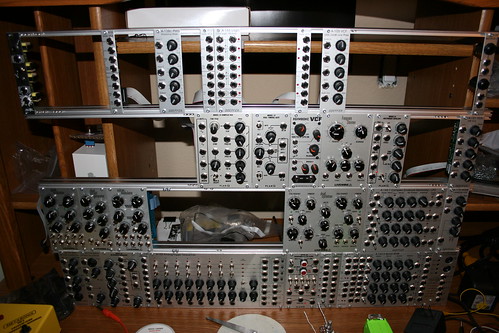
I decided that I would finally get some shit accomplished this weekend and so far, so good.
I went to the local surplus store and got the right length screws this time. They actually have Torx heads, which looks really cool compared to regular phillips head screws. I didn't go through and remove the screws for the modules that I had racked up already, but I'll do that eventually.
I racked the rest of the modules into the vector rails and stacked them up. Now all I need is to find some 90 degree angle mounting hardware for the rails and some nice looking wood to build the case. I hope to have that wrapped up this weekend too, although, the yard really needs some attention too.
The spaces in the top row are completely arbitrary, although Harvestman Tyme Sefari, Zorlon Cannon and Malgorithm will go up there somewhere, hopefully all in the very near future.
The large open space on the lower left is for the AFGs, which are due to arrive anytime now, since I've got two from the first batch. The 2nd open space, in the lower-middle is for a Plan B M14 Voltage Processor and the Livewire Chaos Computer, whenever that gets released.
All in all, I'm pretty pleased with how it looks. It's actually not as big as I thought it would be in terms of size, both height and depth. It should still be very portable (it's a little smaller than a Doepfer Monster Case).
Off to the hardware store!
Thursday, January 03, 2008
New year's update
Once again, it's been too long since my last update...
Firstly, I hope everyone had a good and relaxing holiday break!
No new modules since the sequencer, money has been slow, but I have got a few more mastering projects coming my way and I did get some money for the holidays but I'm trying not to blow through that so fast. That and, as you'll read, I've got more uses for it. That, and I've learned my lesson about buying stuff before NAMM.
Over the break, I got back into playing guitar more. It started with playing around with the TM-6 as a wah and for about a week I played guitar more than played with the modular. It was involved in a few sounds, using the filters mostly, but I generally was just using the guitar and having a lot of fun. Even not having played (or practiced, which I never did much anyway) I haven't gotten too rusty...it's certainly a lot easier to come up with riffs/lines on the guitar than the synth/keys for me and that's probably why I had so much fun.
This new attention to the guitar also rekindled my lust for pedals. I've always liked pedals, but was always buying and selling them as they didn't hold my attention very long...the few that did though, I have kept and I feel now, years later, that my ears have improved enough that I'm able to pick and choose pedals better.
Through Pete @ Leisure Cove, I got turned onto Build Your Own Clone and the DIY pedal kits that they offer. BYOC has quite a few kits, one that I am particularly excited about, the "Lazy Sproket", a Boss SG-1 Slow Gear clone. Despite it's simplicity, I really liked that pedal, but it was always way too expensive. It's the pedal that actually got me browsing eBay way back in 99 or thereabouts. I was always hunting for a Slow Gear...and was always outbid on the few that came up. Well now, I can build the thing myself for $74.99. Fuckin-A.
All of their kits are very interesting and very well priced. The other's that particularly interest me are the "250+" DOD 250/MXR Dist+ clone as well as their Digital Delay. The icing on the cake is their forum, which has a very active membership with what seems like hundreds of various mods to the kits. I'm *really* excited about getting into this.
In modular news, I've ordered the majority of the parts for my custom case and they should be arriving very soon. I actually ordered 2 extra of the Vector T-strut mounting rails since it was only a few more bucks to get the price break for 10 of them. So if anyone wants 2 rails, let me know and I'll give you a great deal; I don't think I'll have a use for them. I'm hoping to finish the case quickly and not drag ass like I have with the joystick controller. The fact that having the case finished will allow me to sell my Doepfer A-100P suitcases, therefore having money for modules, will be a big motivator. Which reminds me, I'll have 2 Doepfer A-100P cases available for sale soon too; if you are in the market for one (or both!) let me know.
I'm looking forward to NAMM again this year; I always have a good time, but I have very few work-related meetings lined up this year so I'll pretty much be cruising the show the entire time. I've got a few people to say hi to in person now which will be fun to. If any of you want me to check out anything specific @ NAMM, please leave a note in the comments (or this thread on the Muff Wiggler Forum) and I will make sure to check it out and get as many details as possible.
It's not all rainbow farts and sunshine here though, my MacbookPro has fucked itself up nicely. For the last month or so it's been acting oddly when charging batteries and I actually had to replace one of the batteries as it no longer held a charge for more than 30 minutes or so. Now, it simply refuses to run when the battery is used; it will only work when connected to the AC adapter. The battery is fine too, I've tested it with several colleague's MBPs as well as tried their batteries. The shitty part is that my MBP is out of warranty and I didn't buy the extended applecare. I've bought the extended applecare for every mac I've ever owned and never needed it, and this time, ever so ironically, skipped it with this laptop.
Actually the really sucky part is the fact that the wonderful MagSafe connector comes out so easily by design (to save your laptop from flying across the room should someone trip on the power cable)...now if I pickup the thing wrong and the plug pulls out, the computer dies...which has happened like 5 times in the last 2 weeks. Bad sectors anyone!? I've yet to back my system up and take it in for repair, so I'm in for an unknown charge in the near future (another reason to not go splurging on modules.
That's it for now. Adios.
Firstly, I hope everyone had a good and relaxing holiday break!
No new modules since the sequencer, money has been slow, but I have got a few more mastering projects coming my way and I did get some money for the holidays but I'm trying not to blow through that so fast. That and, as you'll read, I've got more uses for it. That, and I've learned my lesson about buying stuff before NAMM.
Over the break, I got back into playing guitar more. It started with playing around with the TM-6 as a wah and for about a week I played guitar more than played with the modular. It was involved in a few sounds, using the filters mostly, but I generally was just using the guitar and having a lot of fun. Even not having played (or practiced, which I never did much anyway) I haven't gotten too rusty...it's certainly a lot easier to come up with riffs/lines on the guitar than the synth/keys for me and that's probably why I had so much fun.
This new attention to the guitar also rekindled my lust for pedals. I've always liked pedals, but was always buying and selling them as they didn't hold my attention very long...the few that did though, I have kept and I feel now, years later, that my ears have improved enough that I'm able to pick and choose pedals better.
Through Pete @ Leisure Cove, I got turned onto Build Your Own Clone and the DIY pedal kits that they offer. BYOC has quite a few kits, one that I am particularly excited about, the "Lazy Sproket", a Boss SG-1 Slow Gear clone. Despite it's simplicity, I really liked that pedal, but it was always way too expensive. It's the pedal that actually got me browsing eBay way back in 99 or thereabouts. I was always hunting for a Slow Gear...and was always outbid on the few that came up. Well now, I can build the thing myself for $74.99. Fuckin-A.
All of their kits are very interesting and very well priced. The other's that particularly interest me are the "250+" DOD 250/MXR Dist+ clone as well as their Digital Delay. The icing on the cake is their forum, which has a very active membership with what seems like hundreds of various mods to the kits. I'm *really* excited about getting into this.
In modular news, I've ordered the majority of the parts for my custom case and they should be arriving very soon. I actually ordered 2 extra of the Vector T-strut mounting rails since it was only a few more bucks to get the price break for 10 of them. So if anyone wants 2 rails, let me know and I'll give you a great deal; I don't think I'll have a use for them. I'm hoping to finish the case quickly and not drag ass like I have with the joystick controller. The fact that having the case finished will allow me to sell my Doepfer A-100P suitcases, therefore having money for modules, will be a big motivator. Which reminds me, I'll have 2 Doepfer A-100P cases available for sale soon too; if you are in the market for one (or both!) let me know.
I'm looking forward to NAMM again this year; I always have a good time, but I have very few work-related meetings lined up this year so I'll pretty much be cruising the show the entire time. I've got a few people to say hi to in person now which will be fun to. If any of you want me to check out anything specific @ NAMM, please leave a note in the comments (or this thread on the Muff Wiggler Forum) and I will make sure to check it out and get as many details as possible.
It's not all rainbow farts and sunshine here though, my MacbookPro has fucked itself up nicely. For the last month or so it's been acting oddly when charging batteries and I actually had to replace one of the batteries as it no longer held a charge for more than 30 minutes or so. Now, it simply refuses to run when the battery is used; it will only work when connected to the AC adapter. The battery is fine too, I've tested it with several colleague's MBPs as well as tried their batteries. The shitty part is that my MBP is out of warranty and I didn't buy the extended applecare. I've bought the extended applecare for every mac I've ever owned and never needed it, and this time, ever so ironically, skipped it with this laptop.
Actually the really sucky part is the fact that the wonderful MagSafe connector comes out so easily by design (to save your laptop from flying across the room should someone trip on the power cable)...now if I pickup the thing wrong and the plug pulls out, the computer dies...which has happened like 5 times in the last 2 weeks. Bad sectors anyone!? I've yet to back my system up and take it in for repair, so I'm in for an unknown charge in the near future (another reason to not go splurging on modules.
That's it for now. Adios.
Wednesday, December 12, 2007
The Devils Carrousel
So here is the patch I mentioned last night after getting the Doepfer A-155.
The A-155 has Pre/Post outputs for each sequencer lane. "Pre" is pre-S+H/Glide processing and Post is post-S+H/Glide processing; but if you don't do any S+H/Glide processing, these are essentially a mult. That's how I used it in this case, with the Pre out going to the 1v/Oct in on the Plan B Model 15 and also into one oscillator's CV in on the Livewire Dalek Modulator which was set to a sine wave and put into one of the Freq CV inputs (linear) of the Model 15. The sine wave output of the M15 is then fed into one half of the M13 Dual Timbal Gate set to "Both" with the level all the way up.
The second lane of the A-155 is controlling the other oscillator of the Dalek, set to square wave and fed into the other half of the M13 Dual Timbral Gate, set to "Filter", with the Level all the way down. This gate is being opened by the Plan B Model 10 Poly EG.
The clock for the A-155 is the square wave output of one half of the Livewire Vulcan Modulator. The Difference output of the Vulcan is set for both square waves and it is being used to trigger the M10 which is opening that lower gate on the M13.
From the SUM output (mix) of the M13, the signal is fed into the Livewire FrequenSteiner, which is then modulated slowly by the triangle wave on the other half of the Vulcan as well as the Auxiliary output of the Livewire Dual Cyclotron. This gives an interesting sound because you don't really notice the Cyclotron's effect on the filter frequency when the Vulcan has swept it all the way up, but as it sweeps down, you can hear the Cyclotron's effect...it makes that kind of square wave gurgling sound when the filter frequency is in the lower range.
Finally, the volume is controlled by one of the EGs on the Doepfer A-143-2 which is being triggered by the Gate row on the A-155 sequencer. The release time is slow so it's really adding only a slight bit of dynamics to the sound. I'm also controlling the overall volume with one axis of my joystick controller inverted through the Doepfer A-175 Dual Inverter.
The final touch is the Moog delay (MF-104) with the Frostwave Resonator in the feedback loop to give it a bit more band-limited tape-delay like sound.
Enjoy.
The A-155 has Pre/Post outputs for each sequencer lane. "Pre" is pre-S+H/Glide processing and Post is post-S+H/Glide processing; but if you don't do any S+H/Glide processing, these are essentially a mult. That's how I used it in this case, with the Pre out going to the 1v/Oct in on the Plan B Model 15 and also into one oscillator's CV in on the Livewire Dalek Modulator which was set to a sine wave and put into one of the Freq CV inputs (linear) of the Model 15. The sine wave output of the M15 is then fed into one half of the M13 Dual Timbal Gate set to "Both" with the level all the way up.
The second lane of the A-155 is controlling the other oscillator of the Dalek, set to square wave and fed into the other half of the M13 Dual Timbral Gate, set to "Filter", with the Level all the way down. This gate is being opened by the Plan B Model 10 Poly EG.
The clock for the A-155 is the square wave output of one half of the Livewire Vulcan Modulator. The Difference output of the Vulcan is set for both square waves and it is being used to trigger the M10 which is opening that lower gate on the M13.
From the SUM output (mix) of the M13, the signal is fed into the Livewire FrequenSteiner, which is then modulated slowly by the triangle wave on the other half of the Vulcan as well as the Auxiliary output of the Livewire Dual Cyclotron. This gives an interesting sound because you don't really notice the Cyclotron's effect on the filter frequency when the Vulcan has swept it all the way up, but as it sweeps down, you can hear the Cyclotron's effect...it makes that kind of square wave gurgling sound when the filter frequency is in the lower range.
Finally, the volume is controlled by one of the EGs on the Doepfer A-143-2 which is being triggered by the Gate row on the A-155 sequencer. The release time is slow so it's really adding only a slight bit of dynamics to the sound. I'm also controlling the overall volume with one axis of my joystick controller inverted through the Doepfer A-175 Dual Inverter.
The final touch is the Moog delay (MF-104) with the Frostwave Resonator in the feedback loop to give it a bit more band-limited tape-delay like sound.
Enjoy.
I Finally Got a Sequencer

As I previously mentioned before, I've been on the lookout for a sequencer, the Doepfer A-155 in particular since the Milton is vaporware for the most part. I actually lost an auction one two weeks ago on ebay, and had been waiting for another to show up.
Then, yesterday, I saw a post to the AH list (I'm just a lurker, not a member) from a guy who was looking to sell one, and he was in Santa Cruz! I went and got it on my lunch break, and pretty much started at it on and off for the rest of the day. I ended up being at work until pretty late so it was about 10pm before I actually got around to plugging it in.
Before hooking it up though, I thought I would give organizing the "portable" system a shot. It wasn't really working out...I couldn't fit all that I wanted into 1 A-100P case...not with the Sequencer. If it was like 12HP or so smaller, then *maybe*. So I'll be starting on a custom case ASAP. With the Sequencer installed, I'm down to 22HP free.
So anyway, everything I said about not wanting a sequencer was simply uneducated bullshit rationalization on my part. I LOVE the sequencer...I think want two now! Just having one row patched to a 2 OSC FM sound was fantastic fun. I played around with it for about 3 hours, trying different clock sources, messing with using one of the trigger rows patched into the sequencer Reset to play with the sequence length in realtime, etc, but I think I've only just broken the surface of using this in patches. The A-154 controller will no doubt be in my future as well, especially if I decide on picking up a second A-155.
I did leave a patch up that I did at the end of the night, I just didn't record it; I'll do that tonight and update the post here with the audio.
Saturday, December 01, 2007
Ghost In The ICs
Before sitting down to wrap up another mastering project and start on yet another (when it rains, it pours) I decided to patch up something on the modular for a while, making a specific effort to use the Polivoks.
After messing around with that sound of the Polivoks self-oscillating with the BP out FM'ing itself that I mentioned in the review, I started a patch using it as a regular BP filter and came up with what I called "Ghost In the ICs".
This quite possibly could be my favorite sound I've come up with yet. I think it could have been even more expressive with the joysticks involved, but it's hard at this stage to play them without the alligator clips popping off or having a flaky connection. Here's what the patch consisted of:
The lower register of the sound (the slightly formant like one) is one square wave oscillator from the Dalek Modulator with a little bit of x-modulation. That is being fed into the Harvestman Polivoks which has it's resonance about 3/4 of the way up, getting a slight modulation of it's frequency by the Auxiliary out of the Dual Cuyclotron (both cyclotrons set to "discrete"; square waves), and the Bandpass output going into one half of the Plan B Dual Timbral Gate with the level up @ 10 o'clock. The gate level is opened by the accent out on the first 8th note of a triplet on the Plan B Model 28 Tap Clock.
The upper register of the sound (higher pitched sine wave-ish one) is the sine wave out of the other half of the Dalek Modulator, also with a little bit of x-modulation. That is going directly into the other half of the Plan B Dual Timbral Gate, with the level also @ 10 o'clock and the gate in "Filter" mode. The gate level is closed slightly (not being opened wider) by a Plan B Model 10 Poly Env, with the envelope going negative (~ 11 o'clock on the knob). The Poly Env is being triggered by the triplet gate output on the Model 28 Tap Clock, with the middle 8th note set to Rest.
The mix/sum output of the Dual Timbral Gate is going into the Frequensteiner with it's Resonance set to ~ 10 o'clock and set to LP mode. It's modulated slowly by the Triangle out of one half of the Vulcan Modulator as well as getting an Accent on the first eighth note (so accents on the quater note beat) from the Model 28.
Finally, the Frequensteiner is going into the main VCA (Doepfer A-131) which is being held open via the "clock divider always on trick" and also slightly modulated by the Triangle out of the other half of the Vulcan Modulator.
I added a little UAD RE-201 and UAD Plate 140 in Logic after recording it.
Enjoy.
After messing around with that sound of the Polivoks self-oscillating with the BP out FM'ing itself that I mentioned in the review, I started a patch using it as a regular BP filter and came up with what I called "Ghost In the ICs".
This quite possibly could be my favorite sound I've come up with yet. I think it could have been even more expressive with the joysticks involved, but it's hard at this stage to play them without the alligator clips popping off or having a flaky connection. Here's what the patch consisted of:
The lower register of the sound (the slightly formant like one) is one square wave oscillator from the Dalek Modulator with a little bit of x-modulation. That is being fed into the Harvestman Polivoks which has it's resonance about 3/4 of the way up, getting a slight modulation of it's frequency by the Auxiliary out of the Dual Cuyclotron (both cyclotrons set to "discrete"; square waves), and the Bandpass output going into one half of the Plan B Dual Timbral Gate with the level up @ 10 o'clock. The gate level is opened by the accent out on the first 8th note of a triplet on the Plan B Model 28 Tap Clock.
The upper register of the sound (higher pitched sine wave-ish one) is the sine wave out of the other half of the Dalek Modulator, also with a little bit of x-modulation. That is going directly into the other half of the Plan B Dual Timbral Gate, with the level also @ 10 o'clock and the gate in "Filter" mode. The gate level is closed slightly (not being opened wider) by a Plan B Model 10 Poly Env, with the envelope going negative (~ 11 o'clock on the knob). The Poly Env is being triggered by the triplet gate output on the Model 28 Tap Clock, with the middle 8th note set to Rest.
The mix/sum output of the Dual Timbral Gate is going into the Frequensteiner with it's Resonance set to ~ 10 o'clock and set to LP mode. It's modulated slowly by the Triangle out of one half of the Vulcan Modulator as well as getting an Accent on the first eighth note (so accents on the quater note beat) from the Model 28.
Finally, the Frequensteiner is going into the main VCA (Doepfer A-131) which is being held open via the "clock divider always on trick" and also slightly modulated by the Triangle out of the other half of the Vulcan Modulator.
I added a little UAD RE-201 and UAD Plate 140 in Logic after recording it.
Enjoy.
Thursday, October 18, 2007
PlayThing-amagoop
The comments (mainly Zerosum's) on the last Thingamagoop post got me thinking about demoing one application of the Thingamagoop. I was initially thinking of video ideas, but as I was playing around I got to jamming with it and it was too fun not to capture.
There is some modular processing applied:
The Thingamagoop (Ghost of Robot TB1X model, although that doesn't really matter) was plugged into the Doepfer A-119 Envelope Follower into the Ext. In of the Dalek Modulator. Ring Out of the Dalek into the Frequensteiner in bandpass mode, through the Doepfer VCA and then finally into the Moog MF-104 delay. There's some slight slow modulation of the Frequensteiner by the Vulcan Modulator and a touch of filter FM from the Plan B Model 15, the amount of which is being randomly controlled by the Dual Cyclotron.
Where the trick comes in is that I have the Threshold on the Envelope Follower set so that when I have my finger over the Thingamagoop's nose (blocking it's photocell), there is no gate output (and therefore no output from the Thingamagoop+modular). So I'm able to mute the sound just by putting my finger over the photocell.
Now, the modular processing imparts only a little bit of character; 90% of what you hear is the Thingamagoop and me flipping it's switches and playing with the LFO speed. It's pretty much impossible to pick out exactly when the FM of the Frequensteiner happens and the Ring Modulation is not that aggressive. I could have easily just run the Thingamagoop into the delay, but the modular added a nice character.
The left most switch on the Thingamagoop selects the "gate mode". Up is a square wave gate, controlled by the LFO speed. Down is no gate at all. It's pretty easy to hear when I switch back and forth. The right most switch is the pitch range. Down is low range, and up is high. You can hear me switch this a few times, in particular there are a few times where I simultaneously switch the gating off and the pitch to the high range...moving your finger over the photocell in this configuration leads to some really cool modulated tibres (which you'll hear). Adjusting the proximity of the "LEDicle" to the photocell of course also changes the pitch and the amount of modulation; I'm moving that back in forth in front of the photocell as well.
I'm able to do this all with the Thingamagoop cradled in both hands...my left thumb over the photocell, right hand fingers moving the LEDicle and switches and my right palm, and sometimes fingers, moving the LFO knob.
All in all, it's really fun to perform and improve with like this! :D
A simple Machinedrum pattern was used for some rhythm (no modular involvement there).
Enjoy, and please comment.
There is some modular processing applied:
The Thingamagoop (Ghost of Robot TB1X model, although that doesn't really matter) was plugged into the Doepfer A-119 Envelope Follower into the Ext. In of the Dalek Modulator. Ring Out of the Dalek into the Frequensteiner in bandpass mode, through the Doepfer VCA and then finally into the Moog MF-104 delay. There's some slight slow modulation of the Frequensteiner by the Vulcan Modulator and a touch of filter FM from the Plan B Model 15, the amount of which is being randomly controlled by the Dual Cyclotron.
Where the trick comes in is that I have the Threshold on the Envelope Follower set so that when I have my finger over the Thingamagoop's nose (blocking it's photocell), there is no gate output (and therefore no output from the Thingamagoop+modular). So I'm able to mute the sound just by putting my finger over the photocell.
Now, the modular processing imparts only a little bit of character; 90% of what you hear is the Thingamagoop and me flipping it's switches and playing with the LFO speed. It's pretty much impossible to pick out exactly when the FM of the Frequensteiner happens and the Ring Modulation is not that aggressive. I could have easily just run the Thingamagoop into the delay, but the modular added a nice character.
The left most switch on the Thingamagoop selects the "gate mode". Up is a square wave gate, controlled by the LFO speed. Down is no gate at all. It's pretty easy to hear when I switch back and forth. The right most switch is the pitch range. Down is low range, and up is high. You can hear me switch this a few times, in particular there are a few times where I simultaneously switch the gating off and the pitch to the high range...moving your finger over the photocell in this configuration leads to some really cool modulated tibres (which you'll hear). Adjusting the proximity of the "LEDicle" to the photocell of course also changes the pitch and the amount of modulation; I'm moving that back in forth in front of the photocell as well.
I'm able to do this all with the Thingamagoop cradled in both hands...my left thumb over the photocell, right hand fingers moving the LEDicle and switches and my right palm, and sometimes fingers, moving the LFO knob.
All in all, it's really fun to perform and improve with like this! :D
A simple Machinedrum pattern was used for some rhythm (no modular involvement there).
Enjoy, and please comment.
Tuesday, October 09, 2007
Recent pictures of the modular

>>>
It's hard to believe, but I haven't actually taken a picture of the modules all racked up before! :/
So here it is, in all it's glory. You'll no doubt notice these somewhat strategically placed holes. From top to bottom, left to right, they will be filled as follows:
Livewire Chaos Computer (not yet released)
Livewire Vulcan Expansion selector thingy (not yet released)
Plan B Model 14 Voltage Processor
Livewire Audio Frequency Generator (aka 'AFG', not yet released)
Plan B Model 15 Complex VCO (ordered and in transit)
Pretty different than the original "mock up" images from way back when. I hadn't even really planned a 2nd case at that point and now I'm already debating how I'm going to handle further expansion. Muff was right, it truly never ends.
Oh, coincidentally, this shot is of the patch I posted about last night; DalekInvasion. Kinda hard to see cause the shot was taken with my phone, but might help if any of you were having a hard time visualizing what I was explaining.
Monday, October 08, 2007
DalekInvasion
This track is more interesting as far as the patch goes than it actually sounds, but I wanted to share anyway...
The main sound source is one square wave oscillator from the Dalek Modulator. It's pitch modulation comes from two sources:
The first is the "stepped" output of the Model 24 Heisenberg, which is paced by one square wave LFO from the Vulcan Modulator, and fed through one half of a Livewire Dual Bissell Generator (slew limiter).
The second source is the other square wave oscillator from the Dalek Modulator, set in Low range and run through the other half of the Dual Bissell Generator. The rate of this oscillator is modulated by the other square wave LFO from the Vulcan Modulator.
Both of these sources are then fed into a Doepfer A-150 Dual Voltage Controlled Switch (only using one of the switches). The switch is controlled by the Model 28 Tap Clock. Every time the quarter note gate is output, it causes the A-150 switch to change from using the first modulation source to using the second. So what you are hearing is the two modulation sources "trading off" every quarter note.
Beyond that, the "main output" of the Dual Cyclotron is modulating the filter cutoff. The Dual Cyclotron has become my favorite filter modulation source. There's something very organic and chaotic about it's modulation and that leads to some very cool timbres when used to modulate a filter (sparingly of course).
Finally, the output of the modular is going into a Moog MF-104 Analog Delay, with the Moog MF-102 Ring Modulator patched into the feedback loop. If you listen carefully, you can hear the delay repeats slowly get more "spacey" sounding. In some cases, it sounds like is almost slowly starting to play in reverse.
Enjoy.
The main sound source is one square wave oscillator from the Dalek Modulator. It's pitch modulation comes from two sources:
The first is the "stepped" output of the Model 24 Heisenberg, which is paced by one square wave LFO from the Vulcan Modulator, and fed through one half of a Livewire Dual Bissell Generator (slew limiter).
The second source is the other square wave oscillator from the Dalek Modulator, set in Low range and run through the other half of the Dual Bissell Generator. The rate of this oscillator is modulated by the other square wave LFO from the Vulcan Modulator.
Both of these sources are then fed into a Doepfer A-150 Dual Voltage Controlled Switch (only using one of the switches). The switch is controlled by the Model 28 Tap Clock. Every time the quarter note gate is output, it causes the A-150 switch to change from using the first modulation source to using the second. So what you are hearing is the two modulation sources "trading off" every quarter note.
Beyond that, the "main output" of the Dual Cyclotron is modulating the filter cutoff. The Dual Cyclotron has become my favorite filter modulation source. There's something very organic and chaotic about it's modulation and that leads to some very cool timbres when used to modulate a filter (sparingly of course).
Finally, the output of the modular is going into a Moog MF-104 Analog Delay, with the Moog MF-102 Ring Modulator patched into the feedback loop. If you listen carefully, you can hear the delay repeats slowly get more "spacey" sounding. In some cases, it sounds like is almost slowly starting to play in reverse.
Enjoy.
Clock divider "always on" trick
So I thought of also adding a category covering "tips and tricks" as I find them. Hopefully you all find them useful. Obviously some will be specific to certain modules, but hopefully some, like this one, will work probably work for any brand of similar functioning module.
I found that with the Doepfer A-160 Clock Divider, when it's powered on without a trigger source, several of the outputs will be "on", sending out a positive gate signal.
When I'm working on patches, a lot of time I want the main amp VCA to be open all the time until I get a patch to where I want it. Until recently, I would patch the output of the filter directly to the mixer, but this was usually more effort since the volume of the signal from the filter might be too loud, or I would have to re-patch a few things when it came time to use the VCA (and then re-adjust gain levels).
Now that I've discovered that the Clock Divider will output a constant "on" for several outputs, I just patch one of those directly to the gate input on the envelope controlling the main amp VCA. Then, once it's time to "play" the patch, I can just un-patch the cable from the Clock Divider into the Gate output from the keyboard and I'm ready to roll.
:D
I found that with the Doepfer A-160 Clock Divider, when it's powered on without a trigger source, several of the outputs will be "on", sending out a positive gate signal.
When I'm working on patches, a lot of time I want the main amp VCA to be open all the time until I get a patch to where I want it. Until recently, I would patch the output of the filter directly to the mixer, but this was usually more effort since the volume of the signal from the filter might be too loud, or I would have to re-patch a few things when it came time to use the VCA (and then re-adjust gain levels).
Now that I've discovered that the Clock Divider will output a constant "on" for several outputs, I just patch one of those directly to the gate input on the envelope controlling the main amp VCA. Then, once it's time to "play" the patch, I can just un-patch the cable from the Clock Divider into the Gate output from the keyboard and I'm ready to roll.
:D
Monday, August 06, 2007
correction
I just wanted to post a correction on what I said about the Doepfer A-105 SSM LP filter in my last post. It doesn't use a Curtis (CEM) chip, but rather the SSM2044 (you would have thought that obvious huh?).
Anyway, it was used in the early Prophets as well as in the Mono/Poly (one of my faves), it's just not a Curtis chip. I had thought the Sequential stuff had always used the CEM chips, but that apparently wasn't until later.
If you click the product link above, you'll get the full rundown.
In other, yet related, news, I believe this is my new favorite filter, at least for LP. I certainly like it's character for traditional LP sounds more than the FrequenSteiner. I'm going to reserve final judgment until I have some saw waves to run through them both, but so far the SSM wins for LP sounds (the FrequenSteiner still has some of the meanest BP and HP sounds I've heard).
Anyway, it was used in the early Prophets as well as in the Mono/Poly (one of my faves), it's just not a Curtis chip. I had thought the Sequential stuff had always used the CEM chips, but that apparently wasn't until later.
If you click the product link above, you'll get the full rundown.
In other, yet related, news, I believe this is my new favorite filter, at least for LP. I certainly like it's character for traditional LP sounds more than the FrequenSteiner. I'm going to reserve final judgment until I have some saw waves to run through them both, but so far the SSM wins for LP sounds (the FrequenSteiner still has some of the meanest BP and HP sounds I've heard).
Tuesday, July 31, 2007
New modules and "The Sword"
Many delays in my posts due to a sequence of things:
1) HP Deathly Hallows released
2) My Birthday (26 now)
3) Family in town to visit
Of course, right there between 2 and 3 I got the final "big" shipment of Modules from Analogue Haven. I say "big" because it was more than 1 or 2 modules (8 to be exact) and will likely be the last shipment of such a quantity. I still have a couple more modules to purchase, so it's not the last of the orders...just the last of the "big" ones.
This order brought the Plan B Model 28 Tap Clock (fucking outstanding!), Plan B Model 10 Poly Env (super cool and a great alternative to regular EGs), Livewire Dalek Modulator (super sweet, and my first real oscillators, even if they don't track 1v/Oct), as well as some general Doepfer modules (A-138c Mixer, A-150 Voltage Control Switch, and A-160 Clock Divider). The final module, which I was overly surprised about was the Doepfer A-105 SSM LP Filter. This is basically a Curtis-based filter that is supposed to sound like the Prophet, Mono/Poly, anything that used a Curtis filter. I've never really experienced a Curtis filter before, so I didn't know exactly what it sounded like (it's always hard to tell how much a filter influences the character of a particular synth when it's built in), but it is really great sounding! The top end is nice and bitey without being harsh or gritty. It's a perfect complement to the FrequenSteiner! I'm really glad now that I decided to add a second filter, especially this one.
The Dalek Modulator is also very cool and I have really been enjoying having a real oscillator to play with. Gone are times of having to use the FrequenSteiner self-oscillate just to get an audio tone. The timbres that can come out of the Dalek are quite interesting and beyond what I expected, even with my experience with the Moog MF-102 ring mod. They certainly do each have their own sound. The fact that the ring mod section can be used independently of the oscillators is also very cool.
I know I'm incredibly behind on the video demos and I will get working on some very soon, but in the mean time, enjoy the following audio demo.
In this patch, the main "lead" sound is actually my guitar through an Effector-13 Soda Meiser with a fairly conservative setting being run through the Doepfer A-105 SSM LP filter which has it's cutoff frequency modulated by the Smooth output of the Plan B Heisenberg Generator. The signal is then run into a VCA being opened by an ADSR triggered at a 1/4 note (thanks to the Doepfer Clock divider and MIDI clock from MachineDrum)
Also running into that VCA (it has two audio inputs, each with atten) is the second audio source which is the Dalek Modulator Ring output. The Carrier is tuned to "E" and is not being modulated. The Modulator, however, is being fully modulated by a CV signal from the Livewire Dual Cycltron which is being attenuated through a VCA by the "Difference" output on the Vulcan Modulator. This is what is causing that rhythmic "shift" in timbre in the background.
The output of the modular+guitar then feeds into the Moog MF-104 analog delay with the Frostwave Resonator in the delay's feedback loop. This just gives the delay a more "tape" sound because each repeat gets a little more filtered and band-limited sounding. I was going to modulate this and get some dub-feedback stuff in there, but I got lazy.
The drums (and MIDI clock for the modular) are from the MachineDrum. Some of those sounds might be preset ones and others ones I programmed, but it's just a simple pattern. I really like the kick sound, it has a lot of attack so it's easy to hear on small speakers, but there is a lot of bass down on the bottom.
Enjoy.
1) HP Deathly Hallows released
2) My Birthday (26 now)
3) Family in town to visit
Of course, right there between 2 and 3 I got the final "big" shipment of Modules from Analogue Haven. I say "big" because it was more than 1 or 2 modules (8 to be exact) and will likely be the last shipment of such a quantity. I still have a couple more modules to purchase, so it's not the last of the orders...just the last of the "big" ones.
This order brought the Plan B Model 28 Tap Clock (fucking outstanding!), Plan B Model 10 Poly Env (super cool and a great alternative to regular EGs), Livewire Dalek Modulator (super sweet, and my first real oscillators, even if they don't track 1v/Oct), as well as some general Doepfer modules (A-138c Mixer, A-150 Voltage Control Switch, and A-160 Clock Divider). The final module, which I was overly surprised about was the Doepfer A-105 SSM LP Filter. This is basically a Curtis-based filter that is supposed to sound like the Prophet, Mono/Poly, anything that used a Curtis filter. I've never really experienced a Curtis filter before, so I didn't know exactly what it sounded like (it's always hard to tell how much a filter influences the character of a particular synth when it's built in), but it is really great sounding! The top end is nice and bitey without being harsh or gritty. It's a perfect complement to the FrequenSteiner! I'm really glad now that I decided to add a second filter, especially this one.
The Dalek Modulator is also very cool and I have really been enjoying having a real oscillator to play with. Gone are times of having to use the FrequenSteiner self-oscillate just to get an audio tone. The timbres that can come out of the Dalek are quite interesting and beyond what I expected, even with my experience with the Moog MF-102 ring mod. They certainly do each have their own sound. The fact that the ring mod section can be used independently of the oscillators is also very cool.
I know I'm incredibly behind on the video demos and I will get working on some very soon, but in the mean time, enjoy the following audio demo.
In this patch, the main "lead" sound is actually my guitar through an Effector-13 Soda Meiser with a fairly conservative setting being run through the Doepfer A-105 SSM LP filter which has it's cutoff frequency modulated by the Smooth output of the Plan B Heisenberg Generator. The signal is then run into a VCA being opened by an ADSR triggered at a 1/4 note (thanks to the Doepfer Clock divider and MIDI clock from MachineDrum)
Also running into that VCA (it has two audio inputs, each with atten) is the second audio source which is the Dalek Modulator Ring output. The Carrier is tuned to "E" and is not being modulated. The Modulator, however, is being fully modulated by a CV signal from the Livewire Dual Cycltron which is being attenuated through a VCA by the "Difference" output on the Vulcan Modulator. This is what is causing that rhythmic "shift" in timbre in the background.
The output of the modular+guitar then feeds into the Moog MF-104 analog delay with the Frostwave Resonator in the delay's feedback loop. This just gives the delay a more "tape" sound because each repeat gets a little more filtered and band-limited sounding. I was going to modulate this and get some dub-feedback stuff in there, but I got lazy.
The drums (and MIDI clock for the modular) are from the MachineDrum. Some of those sounds might be preset ones and others ones I programmed, but it's just a simple pattern. I really like the kick sound, it has a lot of attack so it's easy to hear on small speakers, but there is a lot of bass down on the bottom.
Enjoy.
Monday, July 16, 2007
what the frac!?
So I'm not even finished with my 2 case euro-rack modular and I already have seen some frac-rack format modules that "I absolutely must have".
Of course, once the euro-rack is finished, that might turn out to be a gross exaggeration, but as of right now that's where it stands. The modules also do not have a direct euro-rack equivalent, so that makes them all the more covet-worthy. Luckily I have not found more than 1 "frac rack" of modules that I would like, so I wouldn't be sinking a bunch of money into it like I have with the euro-rack. That's at least comforting as well as the fact that the rack/PSU for the frac format is *much* cheaper than it's euro-rack equivalent (although to be honest, looks more bulky and "janky" than the Doepfer cases).
The module that caught my eye the most was the Blacet Miniwave. Thanks to zerosum's many demos, it's the one that I'd happily buy the frac format case just to have this module. It's essentially a wave-rom lookup module but can achieve many things because of this. Quantizer, Oscillator, Fuzz, Wacky-ass-control-voltage-source, etc. There's also additional ROMs that can be purchases and each wave form is CV selectable in the bank. The only thing that comes close to this on euro that I know of is the Doepfer A-112 Wavetable Sampler/OSC and it doesn't seem anywhere near as versatile.
Secondly, the Blacet Binary Zone is a voltage pattern generator. It also has on-board lag processing and accepts internal clock. It makes some rad sounding control voltages and the only way that I can explain is it is to have you check out that product page and listen to the demos. I might be able to cook up something similar with several of my planned euro modules, but why not have one module that serves the same purpose. I love tempo-accurate random stuff so this is basically right up my alley.
The third module is the Wiard Noise Ring. This module is essentially a random voltage generator (ie sample + hold), however, it has logic to govern the frequency of drastic changes and how drastic the change is. Think of it as a more musical sample+hold. I think this would be a very interesting complement to my Plan B Model 24 (Heisenberg) as I consider it a very "musical" sample+hold.
There are also other interesting offerings particularly the Borg and Boogie filters from Wiard. These look cool and would certainly fill out the extra spaces of a frac chassis, but I'm most interested in the main three that I listed. I'm not one of those guys who needs every kind of variation of filter or oscillator, but I don't think I can pass up the unique functionality of the MiniWave, Binary Zone, and the Noise Ring. I also *REALLY* like the Wiard Woggle Bug, but that is not made in the frac format. As much as I want one, I can't justify investing in a 3rd format just for that...sure there are other rad 300 modules, but I'll just be carried away to the poor house; albeit with a fine soundtrack ;)
Either way, it's a long way out...both in time and money.
Of course, once the euro-rack is finished, that might turn out to be a gross exaggeration, but as of right now that's where it stands. The modules also do not have a direct euro-rack equivalent, so that makes them all the more covet-worthy. Luckily I have not found more than 1 "frac rack" of modules that I would like, so I wouldn't be sinking a bunch of money into it like I have with the euro-rack. That's at least comforting as well as the fact that the rack/PSU for the frac format is *much* cheaper than it's euro-rack equivalent (although to be honest, looks more bulky and "janky" than the Doepfer cases).
The module that caught my eye the most was the Blacet Miniwave. Thanks to zerosum's many demos, it's the one that I'd happily buy the frac format case just to have this module. It's essentially a wave-rom lookup module but can achieve many things because of this. Quantizer, Oscillator, Fuzz, Wacky-ass-control-voltage-source, etc. There's also additional ROMs that can be purchases and each wave form is CV selectable in the bank. The only thing that comes close to this on euro that I know of is the Doepfer A-112 Wavetable Sampler/OSC and it doesn't seem anywhere near as versatile.
Secondly, the Blacet Binary Zone is a voltage pattern generator. It also has on-board lag processing and accepts internal clock. It makes some rad sounding control voltages and the only way that I can explain is it is to have you check out that product page and listen to the demos. I might be able to cook up something similar with several of my planned euro modules, but why not have one module that serves the same purpose. I love tempo-accurate random stuff so this is basically right up my alley.
The third module is the Wiard Noise Ring. This module is essentially a random voltage generator (ie sample + hold), however, it has logic to govern the frequency of drastic changes and how drastic the change is. Think of it as a more musical sample+hold. I think this would be a very interesting complement to my Plan B Model 24 (Heisenberg) as I consider it a very "musical" sample+hold.
There are also other interesting offerings particularly the Borg and Boogie filters from Wiard. These look cool and would certainly fill out the extra spaces of a frac chassis, but I'm most interested in the main three that I listed. I'm not one of those guys who needs every kind of variation of filter or oscillator, but I don't think I can pass up the unique functionality of the MiniWave, Binary Zone, and the Noise Ring. I also *REALLY* like the Wiard Woggle Bug, but that is not made in the frac format. As much as I want one, I can't justify investing in a 3rd format just for that...sure there are other rad 300 modules, but I'll just be carried away to the poor house; albeit with a fine soundtrack ;)
Either way, it's a long way out...both in time and money.
Subscribe to:
Posts (Atom)

